
Akkusativ in German: A Complete A2 Guide to the Direct Object — Articles, Pronouns & Prepositions
Master the German Akkusativ case at A2 — direct objects, all articles (den, einen, keinen), Akkusativ pronouns, key verbs and prepositions, with clear rules and examples.
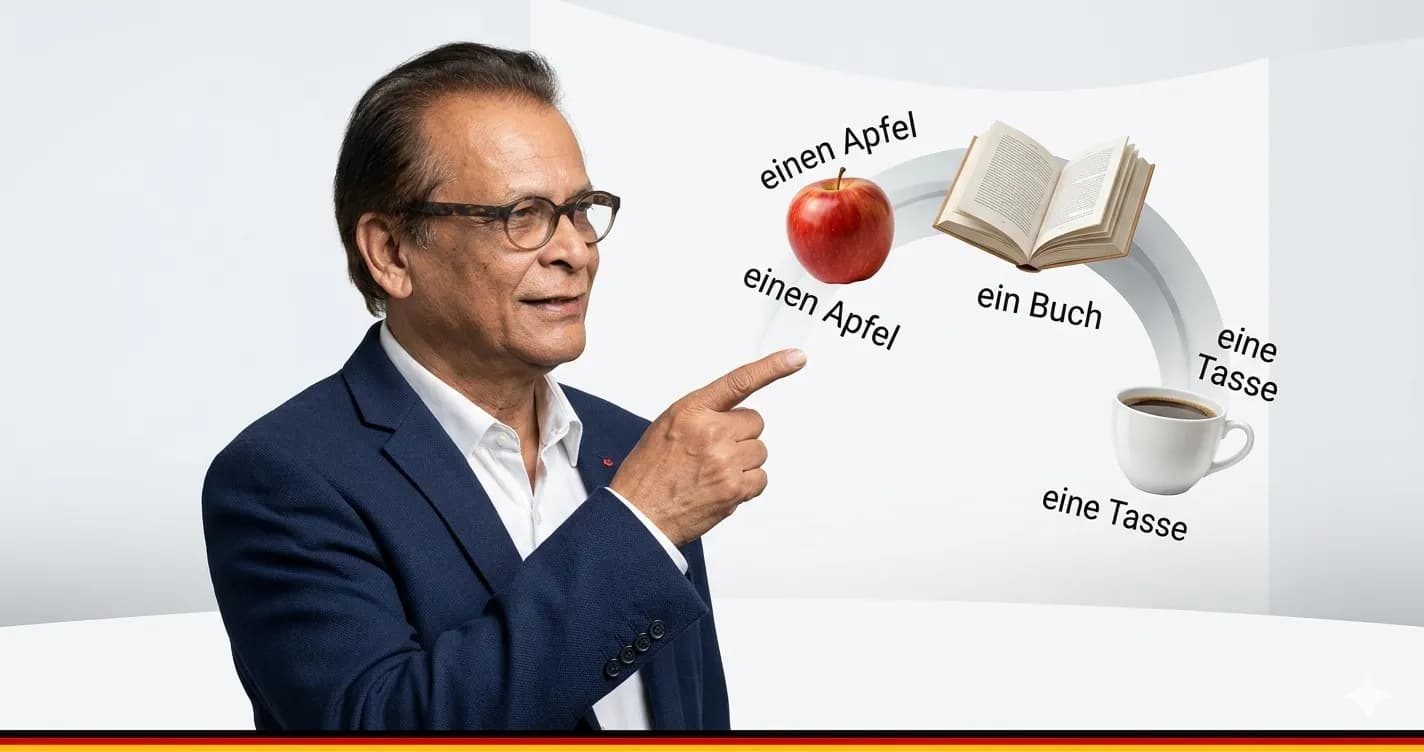
The Akkusativ is the second German case you learn — and the most important step from A1 to A2. It is the case of the direct object: the person or thing that the action of the verb is done to. Once you master Akkusativ, you can express almost any A2 idea: I see her, I want a coffee, I love this song.
This guide covers everything: what Akkusativ is, when to use it, all article changes, pronouns, the verbs that always take Akkusativ, the Akkusativ prepositions, and the most common mistakes.
What Is the Akkusativ Case?
Akkusativ is the case of the direct object — the noun that receives the action.
Question Words: The Akkusativ answers "Wen?" (Whom?) for people or "Was?" (What?) for things.
Example:
- Ich sehe den Mann. — I see the man. (Wen sehe ich? → den Mann)
- Sie kauft ein Buch. — She buys a book. (Was kauft sie? → ein Buch)
The Big Akkusativ Rule (Easy!)
Here is the only thing you really need to memorize: only masculine articles change in Akkusativ. Feminine, neuter, and plural articles stay exactly the same as Nominativ.
Articles in Akkusativ
Definite Articles (the)
- masculine: der → den Mann
- feminine: die → die Frau (no change)
- neuter: das → das Kind (no change)
- plural: die → die Bücher (no change)
Indefinite Articles (a / an)
- masculine: ein → einen Mann
- feminine: eine → eine Frau (no change)
- neuter: ein → ein Kind (no change)
- (no plural for indefinite)
Negative Articles (kein)
- masculine: kein → keinen Mann
- feminine: keine → keine Frau
- neuter: kein → kein Kind
- plural: keine → keine Bücher
Possessive Articles (mein, dein ...)
- masculine: mein → meinen Bruder
- feminine: meine → meine Schwester
- neuter: mein → mein Kind
- plural: meine → meine Eltern
The 80/20 Rule: Just memorize der → den, ein → einen, mein → meinen, kein → keinen. That handles 99% of Akkusativ.
Personal Pronouns in Akkusativ
The pronouns also change form when used as a direct object:
- ich → mich (me)
- du → dich (you)
- er → ihn (him)
- sie → sie (her — no change)
- es → es (it — no change)
- wir → uns (us)
- ihr → euch (you all)
- sie → sie (them — no change)
- Sie → Sie (you formal — no change)
Examples:
- Ich liebe dich. — I love you.
- Sie sieht ihn. — She sees him.
- Wir besuchen euch morgen. — We are visiting you (pl.) tomorrow.
- Er ruft mich an. — He is calling me.
Common Verbs That Take Akkusativ
Most action verbs in German take a direct object in Akkusativ. Memorize these:
- haben — to have
- kaufen — to buy
- essen — to eat
- trinken — to drink
- sehen — to see
- kennen — to know (a person/thing)
- lieben — to love
- brauchen — to need
- nehmen — to take
- besuchen — to visit
- hören — to hear
- lesen — to read
- schreiben — to write
- verstehen — to understand
- finden — to find / think (something is good)
Example sentences:
- Ich habe einen Bruder. — I have a brother.
- Er kauft einen Computer. — He is buying a computer.
- Wir trinken einen Tee. — We are drinking a tea.
- Sie liest das Buch. — She is reading the book.
- Ich finde den Film interessant. — I find the film interesting.
Akkusativ Prepositions — The "FUDGEBOW" List
These prepositions always take Akkusativ. Memorize them as a phrase:
- für — for
- um — around / at (time)
- durch — through
- gegen — against
- entlang — along (after the noun)
- bis — until
- ohne — without
Examples:
- Das Geschenk ist für meinen Vater. — The gift is for my father.
- Wir gehen um den Park. — We walk around the park.
- Sie fährt durch die Stadt. — She drives through the city.
- Ich bin gegen den Plan. — I am against the plan.
- Bitte warten Sie bis nächsten Montag. — Please wait until next Monday.
- Ich trinke Tee ohne Zucker. — I drink tea without sugar. (no article needed here)
Memorize the trick: "für, um, durch, gegen, ohne, bis, entlang" — say it 10 times until it is automatic. Then every prepositional phrase with these words triggers Akkusativ.
Akkusativ Adjective Endings (A2 Level)
When an adjective comes before an Akkusativ noun, the ending changes:
After der/die/das (definite)
- m: den großen Mann (the big man)
- f: die nette Frau
- n: das kleine Kind
- pl: die guten Bücher
After ein/eine/mein/kein (indefinite)
- m: einen großen Mann
- f: eine nette Frau
- n: ein kleines Kind
- pl: meine guten Bücher
Pattern: in Akkusativ, only the masculine ending is "-en" with the article showing the case.
Word Order with Akkusativ Object
Standard order in a main clause:
- Subject
- Verb (position 2)
- Time / Manner / Place
- Akkusativ object (often before time/place is also fine)
Most common position: Ich kaufe einen Apfel im Supermarkt.
Common Mistakes to Avoid
Mistake 1: Using Nominativ where Akkusativ is needed
❌ Ich sehe der Mann.
✅ Ich sehe den Mann.
Mistake 2: Wrong pronoun
❌ Er liebt ich.
✅ Er liebt mich.
Mistake 3: Wrong adjective ending
❌ Ich kaufe ein groß Auto.
✅ Ich kaufe ein großes Auto.
Mistake 4: Forgetting Akkusativ after FUDGEBOW prepositions
❌ Das ist für mein Vater.
✅ Das ist für meinen Vater.
Practice — Convert to Akkusativ
Each starts in Nominativ; rewrite as Akkusativ object:
- (der Lehrer) → Ich kenne den Lehrer.
- (eine Tasse Tee) → Sie trinkt eine Tasse Tee.
- (mein Bruder) → Ich liebe meinen Bruder.
- (kein Geld) → Er hat kein Geld.
- (du) → Ich rufe dich an.
- (für + er) → Das ist für ihn.
Summary
- Akkusativ = direct object (Wen? / Was?).
- Only the masculine article changes: der → den, ein → einen, kein → keinen.
- Pronouns: ich → mich, du → dich, er → ihn, wir → uns, ihr → euch.
- FUDGEBOW prepositions always take Akkusativ.
- Most action verbs take Akkusativ objects.
Daily Practice: Write 5 sentences every day with Akkusativ objects. Cover all four genders. After two weeks, the case becomes automatic — and your German feels noticeably more natural.
Want guided A2 grammar with daily writing feedback? GC Language Institute Lahore offers full A2 courses with case-by-case practice and conversation drills.
Ready to Start Learning German?
Join GC Language Institute — Lahore's most trusted German academy.
Enroll Now