
German Articles and Adjectives: How to Use Them — A Complete A1 Guide
Learn how German articles (der, die, das) and adjectives work together — definite vs indefinite, predicative vs attributive adjectives, gender agreement, and the most common A1 patterns.
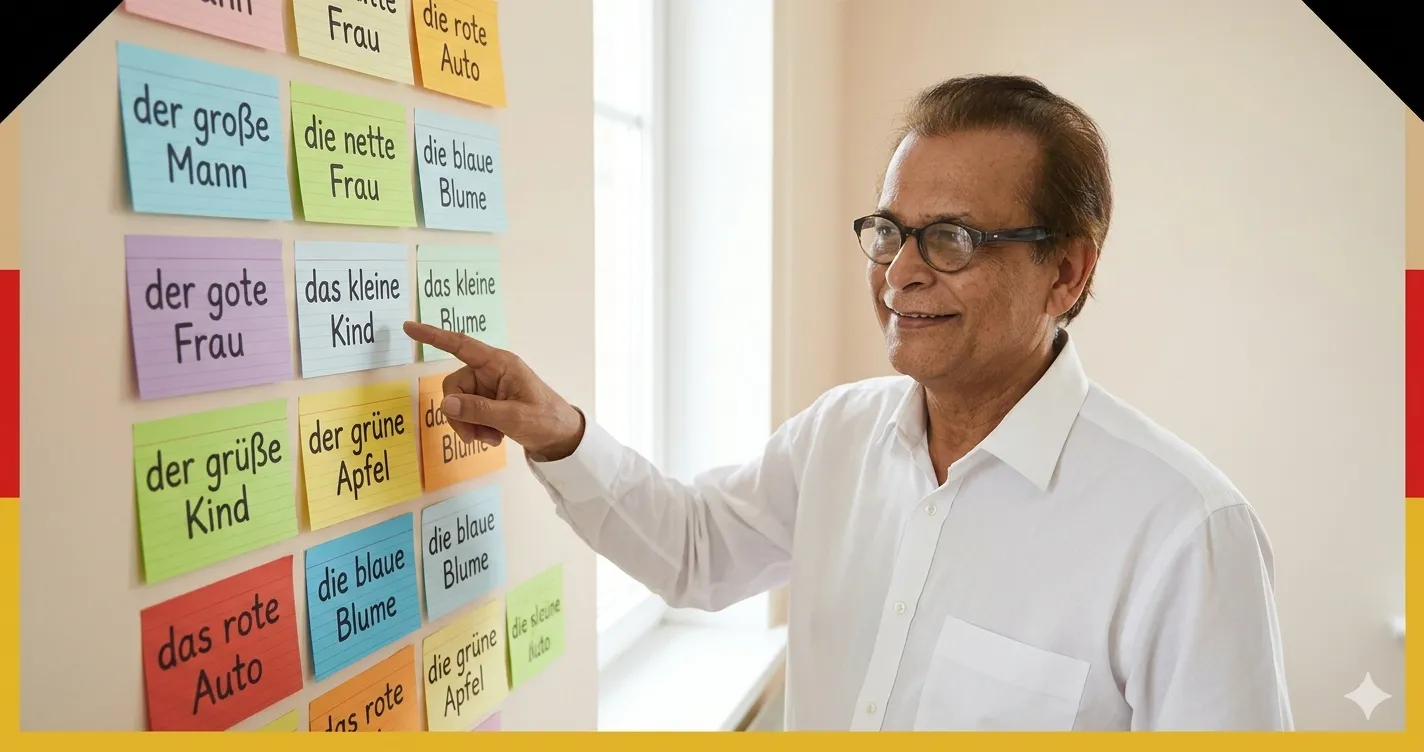
German nouns never travel alone. They almost always come with an article — and very often with an adjective too. Together, articles and adjectives tell you everything about a noun: its gender, number, and quality.
This A1 guide explains exactly how articles and adjectives work, when adjectives change form, when they do not, and the rules every beginner needs to start describing the world in German.
Quick Review: What Is an Article?
An article is a small word that comes before a noun and tells you about its gender and definiteness.
Definite Articles ("the")
- der Mann (m), die Frau (f), das Kind (n), die Bücher (pl)
Indefinite Articles ("a / an")
- ein Mann (m), eine Frau (f), ein Kind (n) — no plural form
Negative Articles ("no / not a")
- kein Mann, keine Frau, kein Kind, keine Bücher
Possessive Articles ("my, your, his, her...")
- mein Vater, meine Mutter, mein Kind, meine Eltern
Always memorize the noun with its article. Not "Tisch" but "der Tisch". Not "Tasche" but "die Tasche". The article is part of the noun in your memory.
What Is an Adjective?
An adjective describes a noun — its quality, size, color, age, opinion, etc.
Common A1 adjectives:
- groß (big), klein (small), neu (new), alt (old)
- jung (young), schön (beautiful), hässlich (ugly)
- gut (good), schlecht (bad), nett (nice), lieb (kind)
- schnell (fast), langsam (slow), teuer (expensive), billig (cheap)
- rot (red), blau (blue), grün (green), gelb (yellow), schwarz (black), weiß (white)
- kalt (cold), warm (warm), heiß (hot)
- schwer (difficult/heavy), leicht (easy/light), interessant (interesting)
Two Positions for an Adjective
This is the most important A1 concept about adjectives:
Position 1: Predicative (after sein/werden/bleiben)
When an adjective comes after the verb — describing the subject — it does NOT change form. It stays in its dictionary form.
- Der Mann ist groß. — The man is tall.
- Die Frau ist nett. — The woman is nice.
- Das Buch ist interessant. — The book is interesting.
- Die Kinder sind klein. — The children are small.
Easy Rule: Predicative adjective = no ending. Same form for all genders, all numbers.
Position 2: Attributive (before the noun)
When an adjective comes before the noun, it MUST take an ending. The ending depends on the article and the gender.
Compare these two:
- Der Mann ist groß. (predicative — no ending)
- Der große Mann ist hier. (attributive — with ending)
Adjective Endings — A1 Simplified Version
The full system has three declension types (strong, weak, mixed). At A1, you only need two simple patterns: with the definite article and with the indefinite article (Nominativ only — Akkusativ comes in A2).
Pattern 1: After der / die / das (definite article)
- der große Mann (m)
- die nette Frau (f)
- das kleine Kind (n)
- die guten Bücher (pl)
Rule: After der → adjective ending is -e (singular) or -en (plural).
Pattern 2: After ein / eine / mein / kein (indefinite or possessive)
- ein großer Mann (m) — adjective takes the gender ending the article cannot show
- eine nette Frau (f)
- ein kleines Kind (n)
- meine guten Bücher (pl)
Rule: When the article does not show gender clearly (ein looks same for m and n), the adjective shows the gender with -er, -e, -es endings.
Pattern 3: No article (zero article)
- kalter Kaffee (m) — cold coffee
- warme Milch (f) — warm milk
- frisches Brot (n) — fresh bread
- nette Leute (pl) — nice people
Rule: Without any article, the adjective itself carries the gender ending (-er, -e, -es, -e).
The Big Idea: Either the article shows the gender, or the adjective does. Someone has to do it. That is the entire system.
Adjectives Used in Daily Sentences
- Mein Bruder ist klug. — My brother is smart.
- Ich habe einen guten Lehrer. — I have a good teacher.
- Das Wetter ist heute schön. — The weather is beautiful today.
- Sie trägt eine rote Tasche. — She is wearing a red bag.
- Wir wohnen in einem kleinen Haus. — We live in a small house.
- Der Kaffee ist sehr heiß. — The coffee is very hot.
Comparing Two Things — Comparative (A1 Intro)
To compare, add -er to the adjective. Use als for "than".
- klein → kleiner: Mein Bruder ist kleiner als ich.
- schnell → schneller: Das Auto ist schneller als das Fahrrad.
For "the most" (superlative): am ___sten
- klein → am kleinsten: Mein Bruder ist am kleinsten.
Some irregular: gut → besser → am besten; viel → mehr → am meisten; gern → lieber → am liebsten.
Common Mistakes to Avoid
Mistake 1: Adding endings to predicative adjectives
❌ Der Mann ist großer.
✅ Der Mann ist groß.
Mistake 2: Forgetting endings on attributive adjectives
❌ Ich sehe ein groß Mann.
✅ Ich sehe einen großen Mann.
Mistake 3: Wrong gender = wrong ending
❌ die kleines Kind
✅ das kleine Kind
Mistake 4: Forgetting article + adjective agreement
❌ der nett Mann
✅ der nette Mann
Summary
- Articles tell you the noun gender: der/die/das, ein/eine, kein/keine, mein/meine.
- Predicative adjectives (after sein) — no ending.
- Attributive adjectives (before the noun) — need an ending.
- Either the article or the adjective must show the gender.
- Compare with -er + als, superlative with am ___sten.
Practice Tip: Pick 5 common nouns (with their articles) and write 3 sentences for each — one with a predicative adjective, one with an attributive adjective, one with no article. Do this every day for two weeks and adjective endings stop being scary.
Need a structured A1 course with daily writing practice and corrections? GC Language Institute Lahore offers complete German courses from A1 to C2 with certified instructors.
Ready to Start Learning German?
Join GC Language Institute — Lahore's most trusted German academy.
Enroll Now