
Dativ Case in German: A Complete B1 Guide to the Indirect Object — Articles, Pronouns, Verbs & Prepositions
Master the German Dativ case at B1 — articles (dem, der, dem, den), pronouns (mir, dir, ihm, ihr), Dativ verbs, the Wechselpräpositionen, and the rules every B1 learner needs.
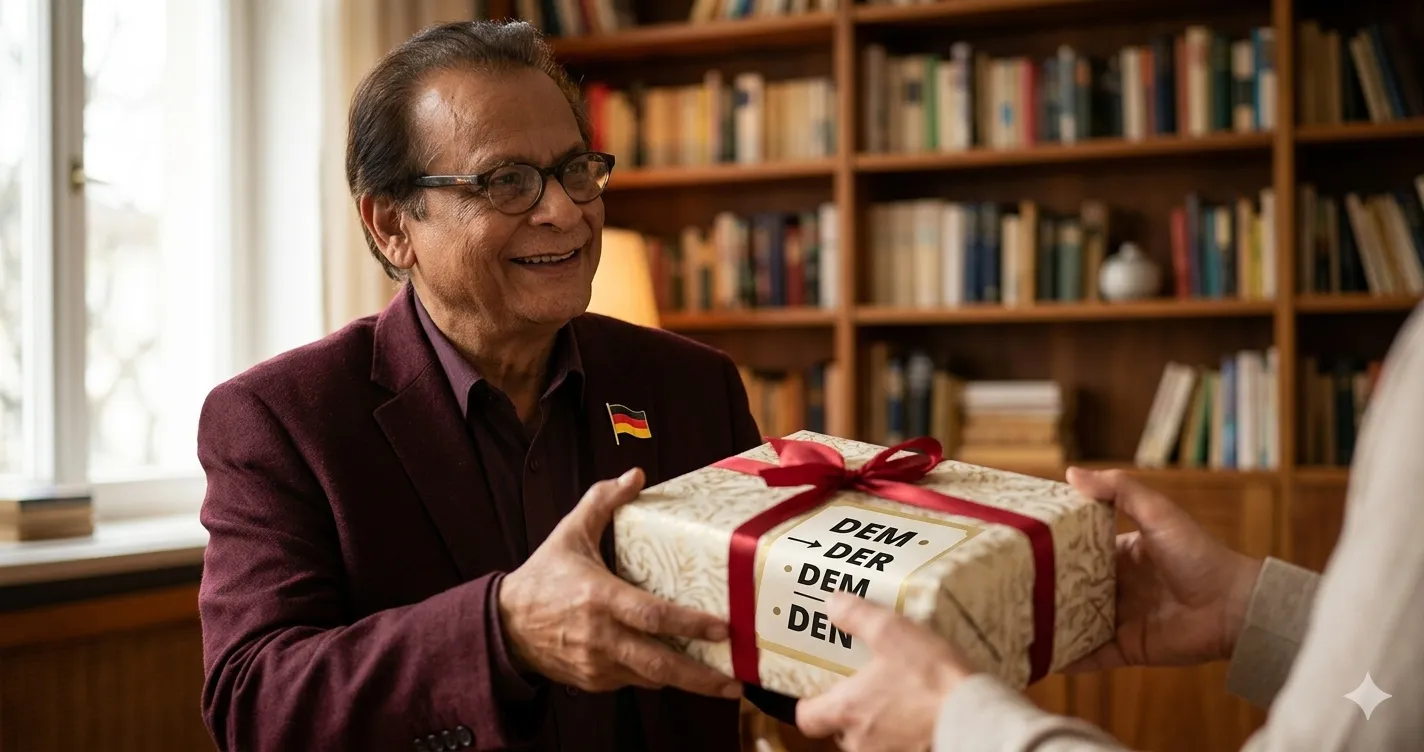
The Dativ is the third German case — and the one that finally makes German feel "complete". It is the case of the indirect object: the person or thing that receives the benefit of the action. I give the book to my brother. The book is the direct object (Akkusativ); my brother is the indirect object (Dativ).
This guide covers every Dativ rule a B1 learner needs: articles, pronouns, the verbs that always take Dativ, the prepositions that always take Dativ, the famous "two-way prepositions" (Wechselpräpositionen), and the most common mistakes.
What Is the Dativ Case?
The Dativ marks the indirect object — usually the recipient or beneficiary of an action.
Question Words: Wem? (To whom?) for people, Was? with a verb / preposition pattern for things.
Compare:
- Ich gebe dem Mann (Dativ) das Buch (Akkusativ). — I give the man the book.
- Wem gebe ich das Buch? → dem Mann (Dativ)
- Was gebe ich dem Mann? → das Buch (Akkusativ)
Articles in Dativ
This is the most important table at B1. All four genders change in Dativ:
Definite Articles (the)
- m: der → dem Mann
- f: die → der Frau
- n: das → dem Kind
- pl: die → den Männern (note: noun also adds -n in plural Dativ!)
Indefinite Articles (a / an)
- m: ein → einem Mann
- f: eine → einer Frau
- n: ein → einem Kind
- (no plural)
kein and Possessives
- m/n: kein → keinem; mein → meinem
- f: keine → keiner; meine → meiner
- pl: keine → keinen; meine → meinen
Memory Trick: Dativ endings are "-em, -er, -em, -en" for m/f/n/pl. Repeat 10 times until automatic.
The Plural -n Rule
In Dativ plural, the noun itself adds an -n (if it does not already end in -n or -s):
- die Männer → den Männern
- die Kinder → den Kindern
- die Bücher → den Büchern
- die Frauen → den Frauen (already has -n, no change)
- die Autos → den Autos (ends in -s, no -n)
Personal Pronouns in Dativ
- ich → mir (to me)
- du → dir (to you)
- er → ihm (to him)
- sie → ihr (to her)
- es → ihm (to it)
- wir → uns (to us)
- ihr → euch (to you all)
- sie → ihnen (to them)
- Sie → Ihnen (to you, formal)
Examples:
- Er hilft mir. — He helps me.
- Ich gebe dir das Buch. — I give you the book.
- Wir danken Ihnen. — We thank you.
Verbs That Always Take Dativ
Some verbs take their object in Dativ (not Akkusativ). Memorize this list — Pakistani learners often translate from Urdu/English and forget:
- helfen — to help: Ich helfe meinem Bruder.
- danken — to thank: Ich danke dir.
- gefallen — to please: Das Buch gefällt mir. (I like the book)
- schmecken — to taste good: Die Suppe schmeckt mir.
- passen — to fit / suit: Das passt mir nicht.
- gehören — to belong: Das Buch gehört mir.
- antworten — to answer: Sie antwortet ihrem Vater.
- glauben — to believe (a person): Ich glaube dir.
- gratulieren — to congratulate: Wir gratulieren dir!
- begegnen — to meet by chance: Ich bin ihm begegnet.
- folgen — to follow: Folgen Sie mir.
- zuhören — to listen to: Sie hört dem Lehrer zu.
Big Trap: "I help my brother" is NOT "Ich helfe meinen Bruder" — it is "Ich helfe meinem Bruder." Helfen is Dativ, always.
Prepositions That Always Take Dativ
These nine prepositions ALWAYS take Dativ. Memorize as a phrase:
- aus — out of / from
- bei — at / near / with (a person)
- mit — with
- nach — after / to (a country/city)
- seit — since
- von — from / of
- zu — to (a place / person)
- gegenüber — opposite
- außer — except
Examples:
- Ich komme aus dem Iran. — I come from Iran.
- Wir wohnen bei meinen Eltern. — We live at my parents (house).
- Sie spricht mit ihrer Mutter. — She is speaking with her mother.
- Nach dem Essen gehen wir. — After the meal we are leaving.
- Ich lerne Deutsch seit einem Jahr. — I have been learning German for one year.
- Ich gehe zu meinem Freund. — I am going to my friend.
Mnemonic: "Aus, bei, mit, nach, seit, von, zu — gegenüber, außer too." Recite it daily until it sticks.
Common Contractions
- zu + dem → zum (zum Bahnhof)
- zu + der → zur (zur Schule)
- von + dem → vom (vom Markt)
- bei + dem → beim (beim Arzt)
Wechselpräpositionen — Two-Way Prepositions
These nine prepositions can take Dativ OR Akkusativ depending on meaning:
- an — at / on
- auf — on top of
- hinter — behind
- in — in
- neben — next to
- über — above / about
- unter — under
- vor — in front of
- zwischen — between
The Magic Question — Wo? vs. Wohin?
- Wo? (location, no movement) → Dativ
- Wohin? (direction, movement TOWARD) → Akkusativ
Examples:
- Das Buch liegt auf dem Tisch. (Wo? → Dativ)
- Ich lege das Buch auf den Tisch. (Wohin? → Akkusativ)
- Wir sind im Park. (Wo?)
- Wir gehen in den Park. (Wohin?)
- Die Lampe hängt über dem Sofa. (Wo?)
- Ich hänge die Lampe über das Sofa. (Wohin?)
Master Rule: If the action is "where something IS" → Dativ. If the action is "where something IS GOING" → Akkusativ.
Word Order: Akkusativ + Dativ Together
When a sentence has both Dativ and Akkusativ objects:
Both nouns
Dativ first, Akkusativ second.
- Ich gebe meinem Bruder (Dat) ein Buch (Akk).
One pronoun, one noun
Pronoun first.
- Ich gebe ihm (Dat pronoun) ein Buch (Akk noun).
- Ich gebe es (Akk pronoun) meinem Bruder (Dat noun).
Both pronouns
Akkusativ first, Dativ second.
- Ich gebe es ihm. (Akk → Dat)
Adjective Endings in Dativ
After der/die/das or after ein/mein/kein, the adjective ending in Dativ is mostly -en:
- m: dem guten Mann / einem guten Mann
- f: der guten Frau / einer guten Frau
- n: dem guten Kind / einem guten Kind
- pl: den guten Kindern
Easy: in Dativ, the adjective is almost always -en.
Common Mistakes to Avoid
Mistake 1: Akkusativ instead of Dativ after Dativ verbs
❌ Ich helfe meinen Bruder.
✅ Ich helfe meinem Bruder.
Mistake 2: Wrong case after Wechselpräpositionen
❌ Ich gehe in den Park stehen. (movement to "in")
✅ Ich gehe in den Park. (Akk — wohin)
✅ Ich stehe im Park. (Dat — wo)
Mistake 3: Forgetting the plural -n
❌ mit den Kinder
✅ mit den Kindern
Mistake 4: Wrong pronoun
❌ Er hilft ich.
✅ Er hilft mir.
Practice Sentences
- "I help my mother" → Ich helfe meiner Mutter.
- "The book belongs to him" → Das Buch gehört ihm.
- "I am at the doctor" → Ich bin beim Arzt.
- "We are going to the park" → Wir gehen in den Park. (Akk — wohin)
- "The cat is sleeping under the table" → Die Katze schläft unter dem Tisch. (Dat — wo)
- "I give it to him" → Ich gebe es ihm.
Summary
- Dativ = indirect object (Wem?). Articles change in all genders.
- Articles: dem (m), der (f), dem (n), den + n (pl).
- Pronouns: mir, dir, ihm, ihr, uns, euch, ihnen, Ihnen.
- 9 Dativ-only prepositions: aus, bei, mit, nach, seit, von, zu, gegenüber, außer.
- 9 Wechselpräpositionen: Dativ for location (wo?), Akkusativ for direction (wohin?).
- Many verbs require Dativ: helfen, danken, gefallen, gehören ...
- In Dativ plural, add -n to the noun.
Daily Practice: Pick three Dativ verbs and three Dativ prepositions. Build five sentences with each. Repeat for one week — Dativ stops being scary.
Get personalized B1 grammar coaching with daily Dativ drills at GC Language Institute Lahore — Pakistan most trusted German academy.
Ready to Start Learning German?
Join GC Language Institute — Lahore's most trusted German academy.
Enroll Now