
German Formal & Informal Writing: A Complete B1 Guide to Emails, Letters, and Style
Learn the exact differences between formal and informal German writing — vocabulary, greetings, sentence structure, polite formulas, and full templates for emails, complaints, and applications.
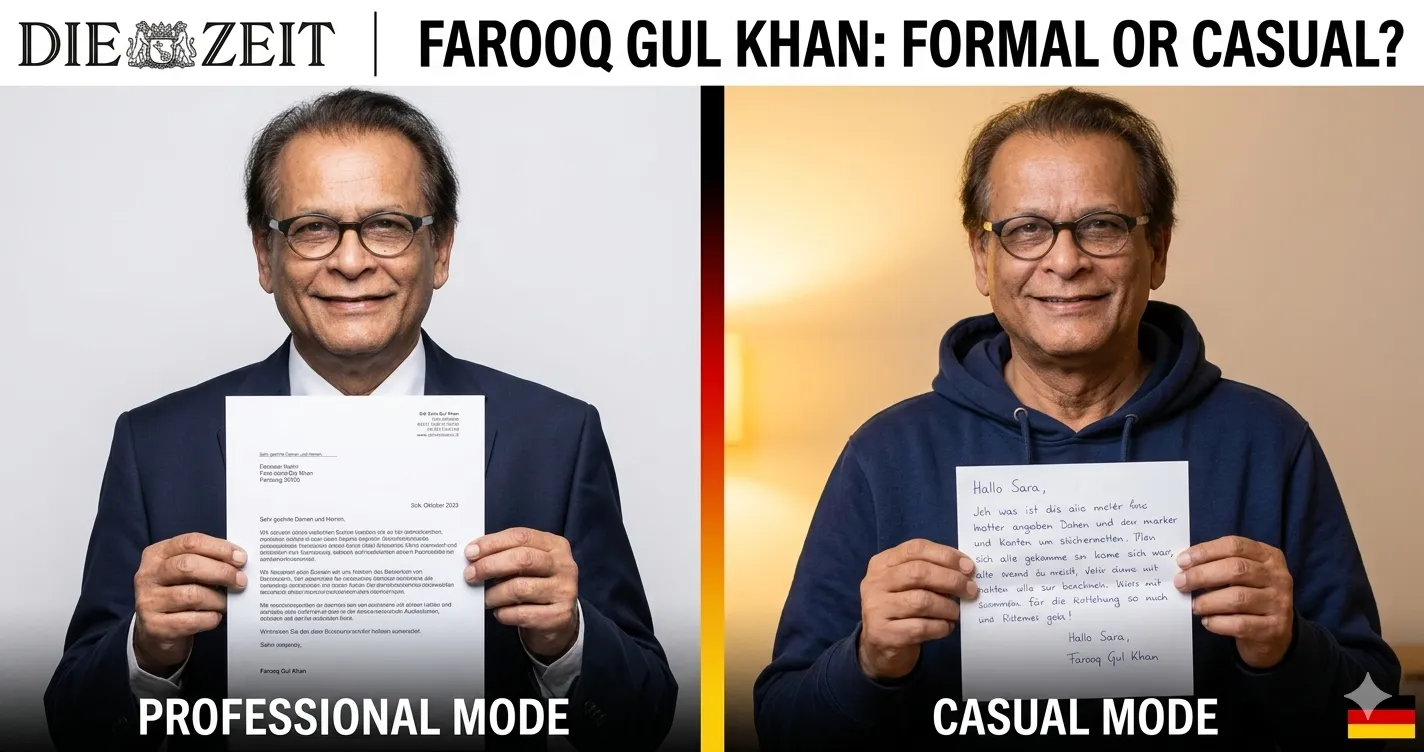
At B1, you must write differently for different audiences. A friend gets a casual message; a landlord gets a formal letter. Mixing styles makes Germans uncomfortable. This guide gives you the exact rules: vocabulary, structure, greetings, and ready-to-use templates for both formal and informal writing.
The Big Distinction
- Informal (du / ihr) — friends, family, classmates, close colleagues.
- Formal (Sie) — businesses, teachers, landlords, officials, strangers, anyone older you do not know personally.
Default Rule: If unsure, go FORMAL. It is always safer to be slightly too polite than too casual.
Vocabulary: Formal vs Informal
Greetings
- Formal: Guten Tag, Sehr geehrte/r Herr / Frau
- Informal: Hallo, Hi, Liebe/r [name]
"You"
- Formal: Sie / Ihnen / Ihr (always capitalized)
- Informal: du / dir / dein (lowercase except start of sentence)
Asking
- Formal: Könnten Sie mir bitte ...?
- Informal: Kannst du mir ...?
Sign-offs
- Formal: Mit freundlichen Grüßen, Hochachtungsvoll
- Informal: Liebe Grüße, Bis bald, Dein/Deine [name]
Sentence Structure Differences
Formal — Longer, Complex Sentences
- Hiermit möchte ich mich für die freundliche Einladung herzlich bedanken.
- Ich wäre Ihnen sehr dankbar, wenn Sie mir eine Bestätigung zukommen lassen könnten.
Informal — Shorter, Simpler Sentences
- Danke für die Einladung!
- Bitte schreib mir, ob du kommst.
Common Polite Formal Phrases
- Sehr geehrte Damen und Herren, — Dear Sir or Madam, (when name unknown)
- Sehr geehrter Herr Schmidt, — Dear Mr. Schmidt,
- Hiermit möchte ich ... — I hereby would like to ...
- Ich schreibe Ihnen, weil ... — I am writing to you because ...
- Vielen Dank im Voraus für Ihre Mühe. — Thank you in advance for your effort.
- Ich freue mich auf Ihre Antwort. — I look forward to your reply.
- Bei Fragen stehe ich Ihnen gern zur Verfügung. — I am at your disposal for any questions.
- Mit freundlichen Grüßen — Yours sincerely
Common Friendly Informal Phrases
- Hallo Sara! / Liebe Sara,
- Wie geht es dir? — How are you?
- Lange nichts von dir gehört! — Long time no hear!
- Ich wollte dich kurz fragen ... — I just wanted to ask you ...
- Vielen Dank für deine Nachricht!
- Schreib mir bald zurück. — Write back soon.
- Liebe Grüße,
- Bis bald,
Formal Email Template — Complaint
Lahore, 12.05.2026

Sehr geehrte Damen und Herren,

vor einer Woche habe ich bei Ihnen einen Laptop bestellt (Bestellnummer: 12345). Leider funktioniert das Gerät nicht richtig. Der Bildschirm flackert ständig, und die Tastatur reagiert nur sehr langsam.

Ich bitte Sie höflich um eine Lösung — entweder einen Austausch des Geräts oder eine vollständige Rückerstattung.

Vielen Dank im Voraus für Ihre Bemühungen. Ich freue mich auf Ihre Antwort.

Mit freundlichen Grüßen
Ali Raza
Formal Email Template — Application / Inquiry
Lahore, 12.05.2026

Sehr geehrte Damen und Herren,

ich schreibe Ihnen mit Bezug auf Ihren A1-Sprachkurs, den ich auf Ihrer Webseite gesehen habe.

Ich interessiere mich sehr für diesen Kurs und hätte gern einige Informationen:
- Wann beginnt der nächste Kurs?
- Wie hoch sind die Gebühren?
- Wie viele Stunden pro Woche findet der Unterricht statt?
- Gibt es eine Probestunde?

Ich freue mich auf Ihre Antwort und bedanke mich im Voraus für Ihre Mühe.

Mit freundlichen Grüßen
Ali Raza
Informal Message Template — to a Friend
Hallo Sara,

wie geht es dir? Ich hoffe, du bist gesund.

Ich schreibe dir, weil ich nächsten Monat nach Berlin fahre. Hast du Lust mitzukommen? Wir könnten zusammen viele Sehenswürdigkeiten besuchen — den Reichstag, das Brandenburger Tor, vielleicht auch die Museumsinsel.

Bitte schreib mir bald zurück, ob du Zeit hast!

Liebe Grüße,
Ali
Informal Message Template — Apology
Lieber Hassan,

es tut mir wirklich leid, dass ich gestern nicht zu deiner Geburtstagsparty kommen konnte. Ich war plötzlich sehr krank und konnte nicht aufstehen.

Ich hoffe, du hattest trotzdem einen schönen Abend! Können wir uns nächste Woche treffen? Ich möchte dir dein Geschenk persönlich bringen.

Bis bald,
Ali
Style Rules — Formal Writing
- Use Sie and capitalize Ihnen, Ihr, Ihre.
- Use Konjunktiv II for politeness: könnte, würde, hätte.
- Avoid contractions and slang.
- Stick to standard greetings and closings.
- Be precise: include relevant numbers (order, date, reference).
- Sign with your full name.
- End with Mit freundlichen Grüßen.
Style Rules — Informal Writing
- Use du (lowercase except sentence start).
- Use shorter, friendlier sentences.
- Express emotion freely (!, ?, :)).
- Use casual phrases ("Ich freue mich auf dich").
- Sign with first name only.
- End with Liebe Grüße or Viele Grüße.
Common Mistakes
Mistake 1: Mixing du and Sie
Pick one and stick with it for the entire letter.
Mistake 2: Using "Hi" in a formal letter
"Hi" is too casual for any formal context. Always start with Sehr geehrte/r ....
Mistake 3: Wrong sign-off
"Liebe Grüße" to a company is too friendly. "Mit freundlichen Grüßen" to your best friend is too cold.
Mistake 4: Capital letter after greeting comma
❌ Hallo Ali, Ich hoffe ...
✅ Hallo Ali, ich hoffe ...
Mistake 5: Forgetting Sie capitalization
In a formal letter, Sie, Ihnen, Ihr, Ihre are ALWAYS capitalized.
The B1 Exam Letter — What Is Tested
Goethe B1 letter writing tests three things:
- Correct register (formal vs informal — get this wrong, lose points).
- Cover all the bullet points in the prompt.
- Proper structure (greeting, body, closing).
Aim for around 80 words. Use 2–3 connectors (weil, dass, aber, wenn). End with the right sign-off.
Summary
- Default to formal with strangers, businesses, officials.
- Use Konjunktiv II in formal writing for politeness.
- Capital Sie/Ihnen/Ihr in formal letters.
- Standard formal closing: Mit freundlichen Grüßen.
- Standard informal closing: Liebe Grüße.
- Never mix registers in the same letter.
Goethe Tip: Memorize one formal opening line and one closing line by heart. With those two anchors, you can adapt to any topic in the exam.
Want B1 exam-ready writing practice with feedback? GC Language Institute Lahore runs structured B1 courses including weekly letter-writing drills and Goethe mock exams.
Ready to Start Learning German?
Join GC Language Institute — Lahore's most trusted German academy.
Enroll Now