
Konjunktiv I in German: A Complete B2 Guide to Indirect Speech (Reported Speech)
Master Konjunktiv I at B2 — formation rules, when to use it for indirect speech, when to switch to Konjunktiv II, news and journalism examples, plus all common patterns.
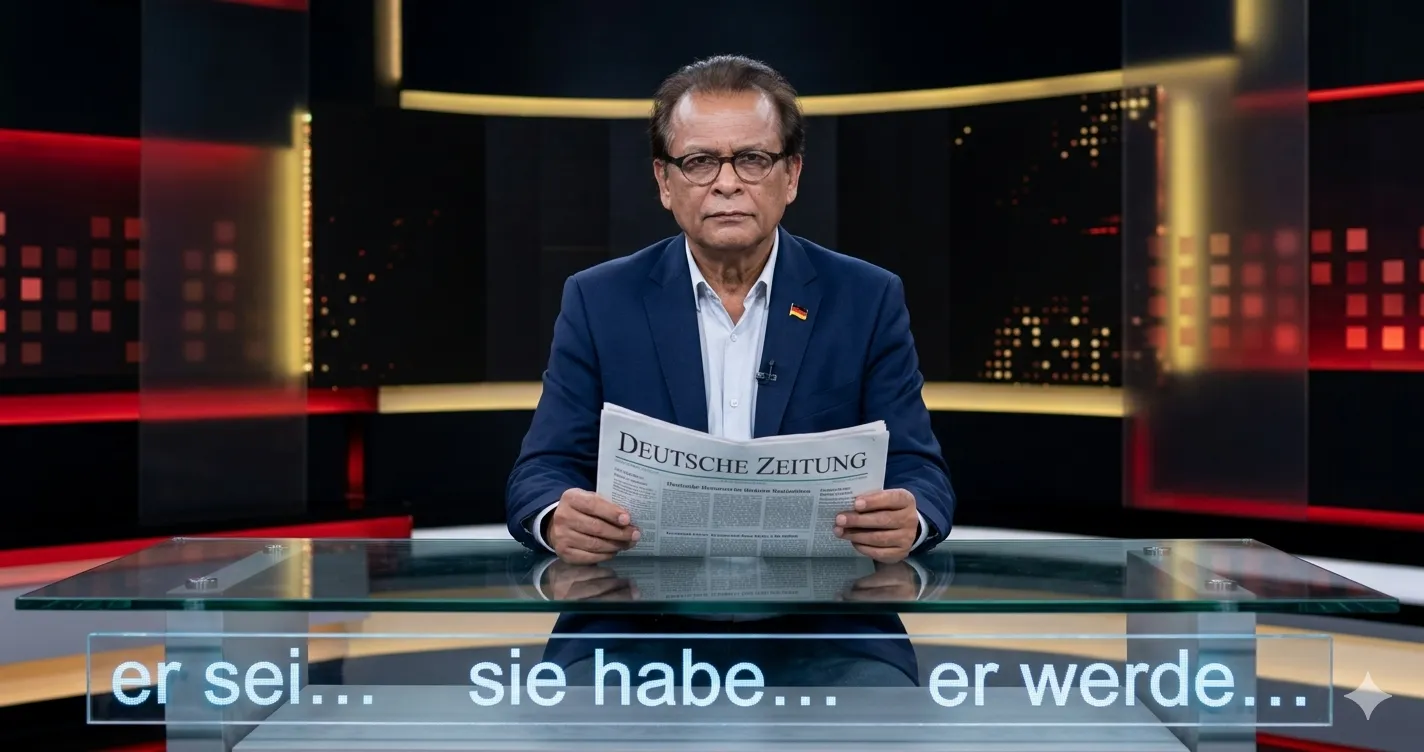
Konjunktiv I (K1) is the German "reported speech" form. When a journalist writes "The minister said the economy is growing," she uses K1: "Der Minister sagte, die Wirtschaft wachse." It signals "this is what someone else said — I am not claiming it is true myself."
K1 is the trademark of news reports, summaries, and academic writing in German. At B2 you must recognize it, form it, and use it in your own reports.
What Does Konjunktiv I Do?
K1 marks indirect speech (reported speech). It tells the reader: "these are someone else's words, reported neutrally."
Compare:
- Direct: Der Minister sagt: "Die Wirtschaft wächst."
- Indirect (K1): Der Minister sagt, die Wirtschaft wachse.
K1 also appears in fixed expressions and instructions:
- Es lebe die Freiheit! — Long live freedom!
- Man nehme zwei Eier. — One takes two eggs. (recipe)
How to Form Konjunktiv I
Take the verb infinitive stem and add the Konjunktiv I endings:
Endings
- ich → -e
- du → -est
- er/sie/es → -e
- wir → -en
- ihr → -et
- sie/Sie → -en
Example: lernen
- ich lerne, du lernest, er lerne, wir lernen, ihr lernet, sie lernen
Notice that for many forms (ich, wir, sie/Sie), Konjunktiv I looks identical to the present indicative. This is a problem — readers cannot tell. So in those cases, German switches to Konjunktiv II or the würde-form.
Important Irregular K1 Forms
The most important K1 form is er/sie/es (third person singular) — because that is what news reports use most often.
sein (to be)
- ich sei, du seist, er sei, wir seien, ihr seiet, sie seien
haben
- ich habe, du habest, er habe, wir haben, ihr habet, sie haben
werden
- ich werde, du werdest, er werde, wir werden, ihr werdet, sie werden
Modal Verbs
- können → er könne
- müssen → er müsse
- wollen → er wolle
- sollen → er solle
- dürfen → er dürfe
- mögen → er möge
The K1 Switch Rule
If the K1 form looks identical to the present indicative, switch to Konjunktiv II or würde + infinitive for clarity.
Example
- "Sie sagen, sie lernen Deutsch." — looks like present, ambiguous
- Better: "Sie sagen, sie würden Deutsch lernen." (K2 würde-form)
- Or: "Sie sagen, sie lernten Deutsch." (K2 form)
The Practical News Pattern (Most Common)
In real journalism, you will see this pattern almost every time:
- Third person singular: use K1 (er sage, sie habe, er müsse, er werde)
- Plural and first person: use K2 / würde-form (sie würden, wir hätten)
K1 in the Past — Reporting Past Events
Indirect speech of past events uses K1 of haben/sein + past participle:
- Direct: Er sagte: "Ich habe das Buch gelesen."
- Indirect: Er sagte, er habe das Buch gelesen.
- Direct: Sie sagte: "Ich bin nach Berlin gefahren."
- Indirect: Sie sagte, sie sei nach Berlin gefahren.
The Three K1 Tenses: Present (er gehe), past (er sei gegangen), future (er werde gehen). All use the K1 form of haben/sein/werden.
From Direct Speech to Indirect Speech — Step by Step
- Identify the original verb tense.
- Convert the verb to K1 (or K2 if K1 looks like present).
- Adjust pronouns ("ich" → "er/sie", "wir" → "sie", etc.).
- Adjust possessives ("mein" → "sein", etc.).
- Adjust time/place markers if needed (today → that day).
- Drop quotation marks; use a comma; do NOT use "dass" (it is implied).
Full Example
- Direct: Anna sagt: "Ich habe heute keine Zeit."
- Indirect: Anna sagt, sie habe heute keine Zeit.
- Direct: Der Polizist sagte: "Sie müssen hier warten."
- Indirect: Der Polizist sagte, wir müssten hier warten. (müssen → müssten because plural would be ambiguous as K1)
Reporting Verbs (Verbs of Saying)
These verbs introduce indirect speech:
- sagen — to say
- behaupten — to claim
- erklären — to explain / declare
- berichten — to report
- antworten — to answer
- fragen — to ask
- hinzufügen — to add
- betonen — to emphasize
- versprechen — to promise
- warnen — to warn
K1 in Real Journalism — Examples
- "Der Bundeskanzler sagte, die Wirtschaft befinde sich auf einem guten Weg."
- "Die Polizei berichtete, der Verdächtige sei gestern festgenommen worden."
- "Der Sprecher betonte, das Unternehmen habe alle Vorschriften eingehalten."
- "Die Forscher erklärten, neue Daten würden bald veröffentlicht."
Indirect Questions
Indirect W-questions keep the W-word; indirect Yes/No questions use ob:
- Direct: "Wann kommst du?"
- Indirect: Sie fragt, wann ich komme.
- Direct: "Hast du Zeit?"
- Indirect: Er fragt, ob ich Zeit habe.
Indirect Commands / Requests
Use sollen in K1 to report a command:
- Direct: "Komm sofort her!"
- Indirect: Er sagte, ich solle sofort herkommen.
For polite requests, use mögen in K1:
- Direct: "Bitte schließen Sie die Tür."
- Indirect: Sie bat mich, ich möge die Tür schließen.
Common Mistakes to Avoid
Mistake 1: Using K1 even when it looks like indicative
"Sie lernen Deutsch" looks present-tense — switch to K2:
✅ Sie sagen, sie lernten Deutsch. (K2 form)
Mistake 2: Using "dass" with K1
You can use "dass + indicative" for normal indirect speech, but K1 is normally used WITHOUT "dass":
✅ Er sagt, er komme. (K1, no dass)
✅ Er sagt, dass er kommt. (indicative, with dass)
❌ Er sagt, dass er komme. (mixing both — sounds awkward)
Mistake 3: Wrong tense for past events
❌ Er sagte, er ging gestern aus. (using simple past)
✅ Er sagte, er sei gestern ausgegangen. (K1 past)
Mistake 4: Forgetting pronoun changes
❌ Anna sagte, ich habe keine Zeit. (still saying "ich" from Anna's view)
✅ Anna sagte, sie habe keine Zeit.
K1 vs K2 — Quick Decision Guide
- Use K1 when the form is clearly different from the present indicative (especially er/sie/es: habe, sei, wache, müsse, werde, gehe).
- Use K2 / würde-form when K1 looks like present indicative (especially plural and ich: würde, hätte, wäre, könnte).
Practice Sentences
- Direct: Sara sagt: "Ich lerne Deutsch."
Indirect: Sara sagt, sie lerne Deutsch. - Direct: Der Lehrer sagte: "Ich habe das Buch gelesen."
Indirect: Der Lehrer sagte, er habe das Buch gelesen. - Direct: Sie fragte: "Kommst du morgen?"
Indirect: Sie fragte, ob ich morgen komme. - Direct: Er sagte: "Wir sind in Berlin."
Indirect: Er sagte, sie seien in Berlin.
Summary
- K1 = indirect speech, the "reported" form.
- Most important forms: sei, habe, werde, müsse, könne, wolle, solle.
- If K1 looks identical to present indicative → switch to K2 / würde-form.
- Past indirect: K1 of haben/sein + past participle.
- Indirect questions: keep W-words; use ob for yes/no.
- Indirect commands: use sollen in K1.
B2 Reading Tip: Pick a German news article every day. Highlight every K1 form. After two weeks, you recognize K1 instantly — and B2 reading scores jump.
At GC Language Institute Lahore, every B2 course covers reported speech, news-style writing, and Goethe B2 exam preparation. Get in touch for structured B2 coaching.
Ready to Start Learning German?
Join GC Language Institute — Lahore's most trusted German academy.
Enroll Now