
German Modal Verbs at A1: Können, Müssen, Wollen, Sollen, Dürfen, Mögen — Complete Guide
Master the six German modal verbs at A1 — full conjugation, sentence structure, meanings, examples, and common mistakes for können, müssen, wollen, sollen, dürfen, and mögen.
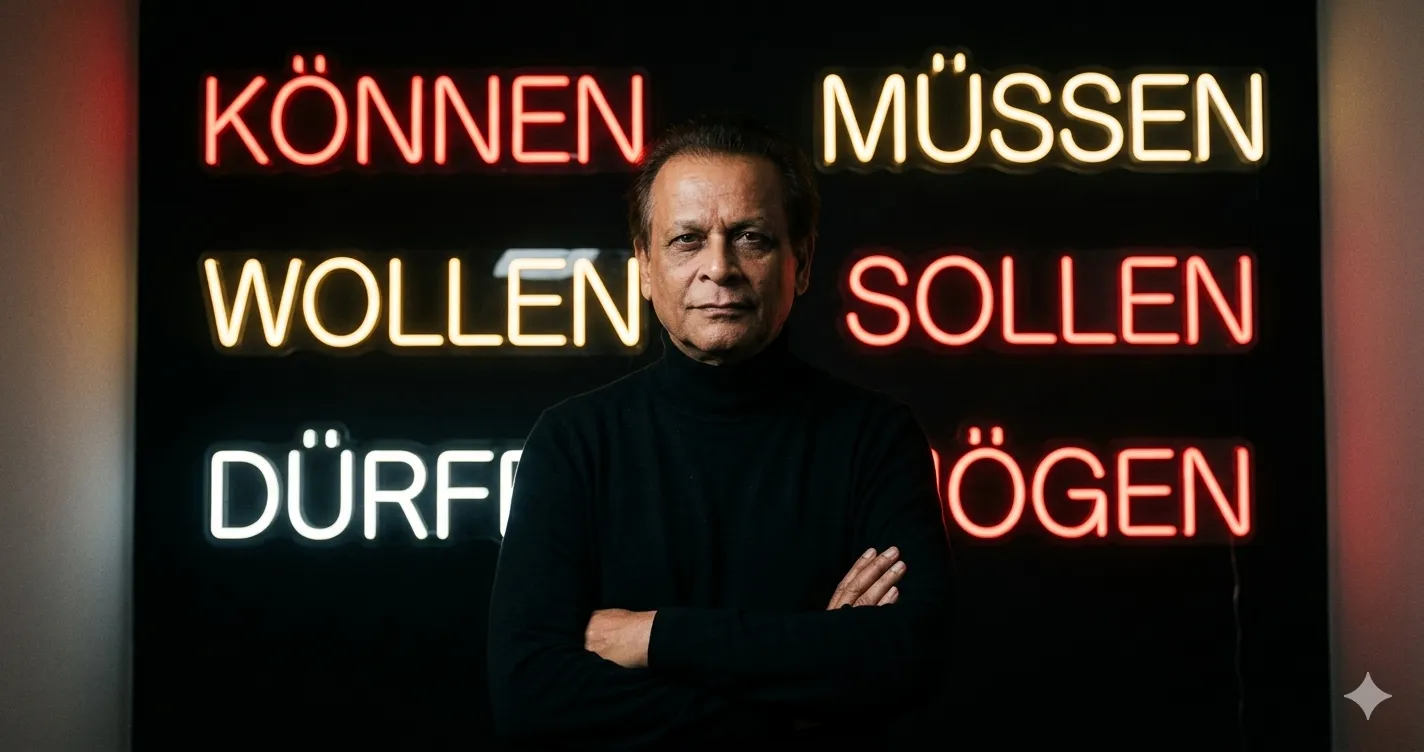
Modal verbs are the most useful verbs in German. With them you can express ability, permission, obligation, desire, and preference — without needing fancy grammar. They also appear in every Goethe A1 exam. Master these six verbs and you can already say almost everything you want in daily conversation.
What Is a Modal Verb?
A modal verb works together with another verb to add meaning. The modal is conjugated and goes in position 2; the second verb is in the infinitive and goes to the very end of the sentence.
Pattern: Subject + modal verb + ... + infinitive. Ich kann gut Deutsch sprechen.
The six modal verbs are:
- können — can / be able to
- müssen — must / have to
- wollen — want to
- sollen — should / supposed to
- dürfen — be allowed to / may
- mögen — like (and its form möchten = would like)
The Modal Verb Conjugation Pattern
Modal verbs share a unique pattern: ich and er/sie/es have the SAME form (no extra ending). Most also change their stem vowel in the singular.
können (can)
- ich kann
- du kannst
- er/sie/es kann
- wir können
- ihr könnt
- sie/Sie können
müssen (must)
- ich muss, du musst, er muss, wir müssen, ihr müsst, sie müssen
wollen (want)
- ich will, du willst, er will, wir wollen, ihr wollt, sie wollen
sollen (should)
- ich soll, du sollst, er soll, wir sollen, ihr sollt, sie sollen
Note: sollen does NOT change vowel in the singular.
dürfen (may / allowed to)
- ich darf, du darfst, er darf, wir dürfen, ihr dürft, sie dürfen
mögen (to like) and möchten (would like)
mögen:
- ich mag, du magst, er mag, wir mögen, ihr mögt, sie mögen
möchten (the polite "would like to" — A1 favorite):
- ich möchte, du möchtest, er möchte, wir möchten, ihr möchtet, sie möchten
Sentence Structure with Modal Verbs
The modal verb is in position 2; the second verb (infinitive) goes to the END.
- Ich kann gut Deutsch sprechen. — I can speak German well.
- Wir müssen jetzt nach Hause gehen. — We must go home now.
- Sie will einen Kaffee trinken. — She wants to drink a coffee.
- Du sollst mehr lernen. — You should study more.
- Hier darf man nicht rauchen. — Smoking is not allowed here.
- Ich möchte ein Glas Wasser haben. — I would like a glass of water.
Meaning and Use of Each Modal Verb
1. können — Ability or possibility
- Ich kann schwimmen. — I can swim.
- Er kann sehr gut kochen. — He can cook very well.
- Können wir hier sitzen? — Can we sit here? (also a polite request)
2. müssen — Obligation / necessity
- Ich muss arbeiten. — I have to work.
- Du musst die Hausaufgaben machen. — You must do the homework.
Negation note: nicht müssen = "do not have to" (not "must not"). For "must not" use nicht dürfen.
3. wollen — Strong wish / intention
- Ich will Deutschland besuchen. — I want to visit Germany.
- Wir wollen heute ins Kino gehen. — We want to go to the cinema today.
Wollen is direct. For polite "I would like to ..." use möchten instead.
4. sollen — Suggestion / instruction from someone else
- Du sollst mehr Wasser trinken. — You should drink more water. (a doctor or parent says so)
- Er soll um 8 Uhr kommen. — He should come at 8 o clock.
Sollen is about external advice or instruction — not your own preference.
5. dürfen — Permission / not allowed
- Darf ich hier parken? — May I park here?
- Hier darf man nicht rauchen. — Smoking is not allowed here.
- Kinder dürfen keinen Alkohol trinken. — Children may not drink alcohol.
6. mögen / möchten — Like / would like
- Ich mag Schokolade. — I like chocolate. (mögen with a noun, no second verb)
- Ich möchte einen Tee. — I would like a tea.
- Wir möchten Deutsch lernen. — We would like to learn German.
Beginner Favorite: möchten is one of the most polite, useful verbs at A1 — perfect for restaurants, shopping, and asking for things. Learn it by heart.
Modal Verbs in Questions
Same as any other verb — move the modal to position 1.
- Kannst du mir helfen? — Can you help me?
- Müssen wir jetzt gehen? — Do we have to go now?
- Möchten Sie etwas trinken? — Would you like something to drink?
- Darf ich Ihnen helfen? — May I help you?
Modal Verbs in Negative Sentences
nicht goes BEFORE the infinitive (and any objects).
- Ich kann heute nicht kommen. — I cannot come today.
- Du sollst nicht rauchen. — You should not smoke.
- Wir müssen das nicht machen. — We do not have to do that.
Modal Verbs Without a Second Verb
Sometimes modal verbs stand alone (with an object) — no infinitive needed:
- Ich kann Deutsch. — I can speak German. (sprechen is implied)
- Ich mag Tee. — I like tea.
- Ich möchte einen Kaffee, bitte. — I would like a coffee, please.
- Wir müssen jetzt los. — We have to go now. (gehen is implied)
Common Mistakes to Avoid
Mistake 1: Conjugating the second verb
❌ Ich kann spreche Deutsch.
✅ Ich kann Deutsch sprechen.
Mistake 2: Wrong word order
❌ Ich muss gehen nach Hause.
✅ Ich muss nach Hause gehen.
Mistake 3: Adding -t to ich/er forms
❌ Ich kannt
✅ Ich kann
Mistake 4: Confusing wollen and möchten
"Ich will einen Kaffee!" sounds rude in a café. Use "Ich möchte einen Kaffee, bitte."
Mistake 5: Misusing nicht müssen
"Du musst nicht kommen" = "You do not have to come" — NOT "You must not come". For "must not" → "Du darfst nicht kommen."
Practice — Build Sentences
- Make a wish: Ich möchte nach Deutschland fahren.
- Express ability: Wir können Englisch sprechen.
- State an obligation: Du musst die Aufgabe machen.
- Ask permission: Darf ich das Fenster öffnen?
- Give advice: Du sollst mehr Wasser trinken.
- Talk about likes: Sie mag Pizza.
Summary
- Six modal verbs: können, müssen, wollen, sollen, dürfen, mögen / möchten.
- Modal in position 2; second verb (infinitive) at the END.
- ich and er/sie/es have the same form — no extra -t.
- Most modals change vowel in singular (kann/muss/will/darf/mag); sollen does not.
- Use möchten for polite requests; wollen is direct.
- "Must not" = nicht dürfen, not nicht müssen.
Mastery Tip: Pick one modal verb per day for a week. Use it 10 times in real sentences about your life. By the end of the week, all six are automatic.
Get personalized A1 coaching with daily speaking practice on every modal verb at GC Language Institute Lahore — Pakistan most trusted German academy.
Ready to Start Learning German?
Join GC Language Institute — Lahore's most trusted German academy.
Enroll Now