
German Numbers Explained: 0 to 1,000,000+ — A Complete A1 Guide with Pronunciation Tips
Master German numbers from zero to a million — counting 0–100, the special "switched" pattern (einundzwanzig), large numbers, ordinals, prices, dates, and phone numbers.
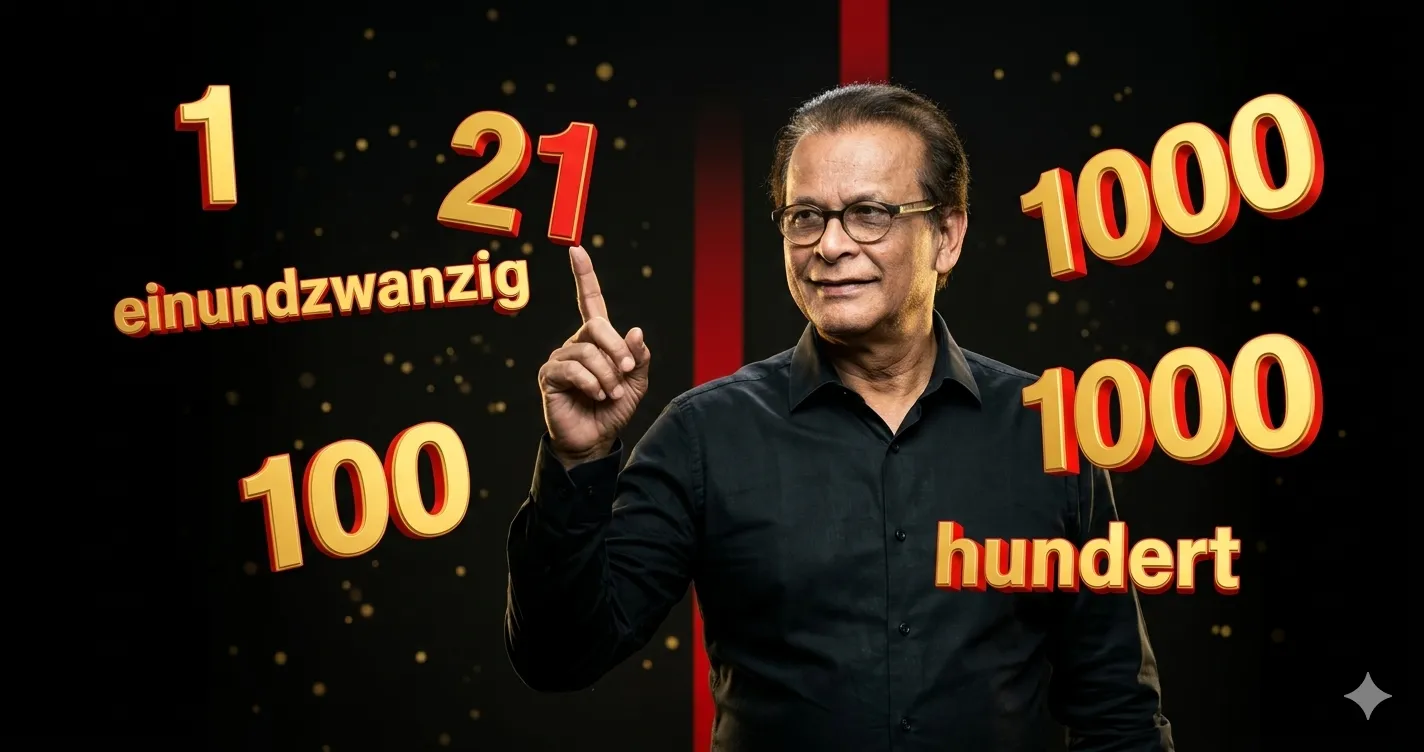
You cannot survive in Germany without numbers — for prices, dates, addresses, phone numbers, ages, and times. The good news? German numbers are 100% logical and follow clear rules. The only "weird" thing is that German says "one-and-twenty" instead of "twenty-one" — and once you learn that one trick, the rest is easy.
This guide takes you from zero to one million, plus ordinals, prices, dates, and phone numbers — everything an A1 student needs.
0 to 12 — Memorize These
- 0 — null
- 1 — eins
- 2 — zwei
- 3 — drei
- 4 — vier
- 5 — fünf
- 6 — sechs
- 7 — sieben
- 8 — acht
- 9 — neun
- 10 — zehn
- 11 — elf
- 12 — zwölf
Pronunciation tip: zwei is sometimes said as "zwo" on phones to avoid confusion with drei.
13 to 19 — Add "-zehn"
Take the digit + zehn:
- 13 — dreizehn
- 14 — vierzehn
- 15 — fünfzehn
- 16 — sechzehn (drop the "s" of sechs!)
- 17 — siebzehn (drop the "en" of sieben!)
- 18 — achtzehn
- 19 — neunzehn
The Tens — 20, 30, 40 ...
- 20 — zwanzig (irregular)
- 30 — dreißig (note: ß, not z)
- 40 — vierzig
- 50 — fünfzig
- 60 — sechzig (no "s")
- 70 — siebzig (no "en")
- 80 — achtzig
- 90 — neunzig
The Famous "und" Pattern (21 to 99)
This is the trick that surprises every English speaker. German says the units BEFORE the tens, joined with und:
- 21 = einundzwanzig (one-and-twenty)
- 22 = zweiundzwanzig
- 35 = fünfunddreißig
- 47 = siebenundvierzig
- 68 = achtundsechzig
- 99 = neunundneunzig
Master Rule: [units] + und + [tens] — written as ONE word. Always.
Note: 21 is einundzwanzig, not einsundzwanzig. The "s" of eins drops when used in compounds.
100 to 999
- 100 — (ein)hundert
- 200 — zweihundert
- 300 — dreihundert ... etc.
- 101 — hunderteins
- 125 — hundertfünfundzwanzig
- 248 — zweihundertachtundvierzig
- 999 — neunhundertneunundneunzig
Pattern: [hundreds] + [tens-units pattern] — all one word.
1,000 and Above
- 1.000 — (ein)tausend
- 2.000 — zweitausend
- 10.000 — zehntausend
- 100.000 — hunderttausend
- 1.000.000 — eine Million
- 1.000.000.000 — eine Milliarde (NOT "billion" — German Milliarde = English billion)
Note the punctuation:
- German uses . (dot) where English uses , (comma) for thousands → 1.000 = 1,000
- German uses , (comma) where English uses . (dot) for decimals → 3,5 = 3.5
Important: "Million" and "Milliarde" are nouns and are written separately (with their article — eine Million). Numbers up to 999,999 are written as one word.
Ordinal Numbers — 1st, 2nd, 3rd
Ordinals end in -te (1–19) or -ste (20+). Most are regular, but the first three are irregular:
- 1. — der/die/das erste (the first)
- 2. — zweite
- 3. — dritte (irregular)
- 4. — vierte
- 5. — fünfte
- 6. — sechste
- 7. — siebte (note: not siebente)
- 8. — achte (note: not achtte)
- 9. — neunte
- 10. — zehnte
- 20. — zwanzigste
- 21. — einundzwanzigste
- 100. — hundertste
Use ordinals for dates, floors, places in a competition:
- Heute ist der 5. Mai. (Heute ist der fünfte Mai.) — Today is the 5th of May.
- Ich wohne im 3. Stock. (im dritten Stock) — I live on the 3rd floor.
Prices and Money
- 1 € = ein Euro
- 1,50 € = "ein Euro fünfzig" or "eins fünfzig"
- 2,99 € = "zwei Euro neunundneunzig"
- 10,00 € = "zehn Euro"
- 1.250 € = "tausendzweihundertfünfzig Euro"
Useful price phrases:
- Was kostet das? — How much does this cost?
- Wie viel macht das? — How much is that?
- Das macht zehn Euro fünfzig. — That comes to €10.50.
Phone Numbers
Phone numbers are usually said in pairs or as single digits:
- 0322 4710128 → "null drei zwo zwo / vier sieben eins null eins zwo acht"
Many Germans say zwo instead of zwei on the phone.
Years
- 1990 — neunzehnhundertneunzig
- 2000 — zweitausend
- 2026 — zweitausendsechsundzwanzig
For years before 2000, Germans split the year into "hundreds + tens-units" — 1990 = nineteen-hundred-ninety.
Common Mistakes to Avoid
Mistake 1: Saying numbers in English order
❌ zwanzigeins for 21
✅ einundzwanzig
Mistake 2: Spelling numbers as separate words
❌ fünf und zwanzig
✅ fünfundzwanzig
Mistake 3: Confusing thousands separators
1.000 in German = 1,000 in English. Comma and dot are reversed.
Mistake 4: Forgetting "eins" drops the "s"
❌ einsundzwanzig
✅ einundzwanzig
Practice — Read These Out Loud
- 17 → siebzehn
- 43 → dreiundvierzig
- 89 → neunundachtzig
- 156 → hundertsechsundfünfzig
- 2026 → zweitausendsechsundzwanzig
- 1.250 € → tausendzweihundertfünfzig Euro
Summary
- 0–12 are unique — memorize them.
- 13–19 = digit + zehn.
- Tens use -zig (except 30 = dreißig).
- 21–99 follow units + und + tens, written as one word.
- Hundreds and thousands chain together: zweihundertvierundfünfzig.
- Ordinals: -te (1–19) or -ste (20+). Watch out for erste, dritte, siebte, achte.
- Decimal point in German is a comma; thousands separator is a dot.
Daily Practice: Read every price, address, and phone number out loud in German for one week. By day 7, even the long numbers feel automatic.
Want native-pace listening practice and pronunciation correction? GC Language Institute Lahore runs full A1 courses with conversation drills built into every lesson.
Ready to Start Learning German?
Join GC Language Institute — Lahore's most trusted German academy.
Enroll Now