
German Passive Voice (Passiv): A Complete B1 Guide to Vorgangs- and Zustandspassiv
Master the German passive voice at B1 — Vorgangspassiv (werden + participle), Zustandspassiv (sein + participle), all tenses, modal passive, and how to switch from active to passive.
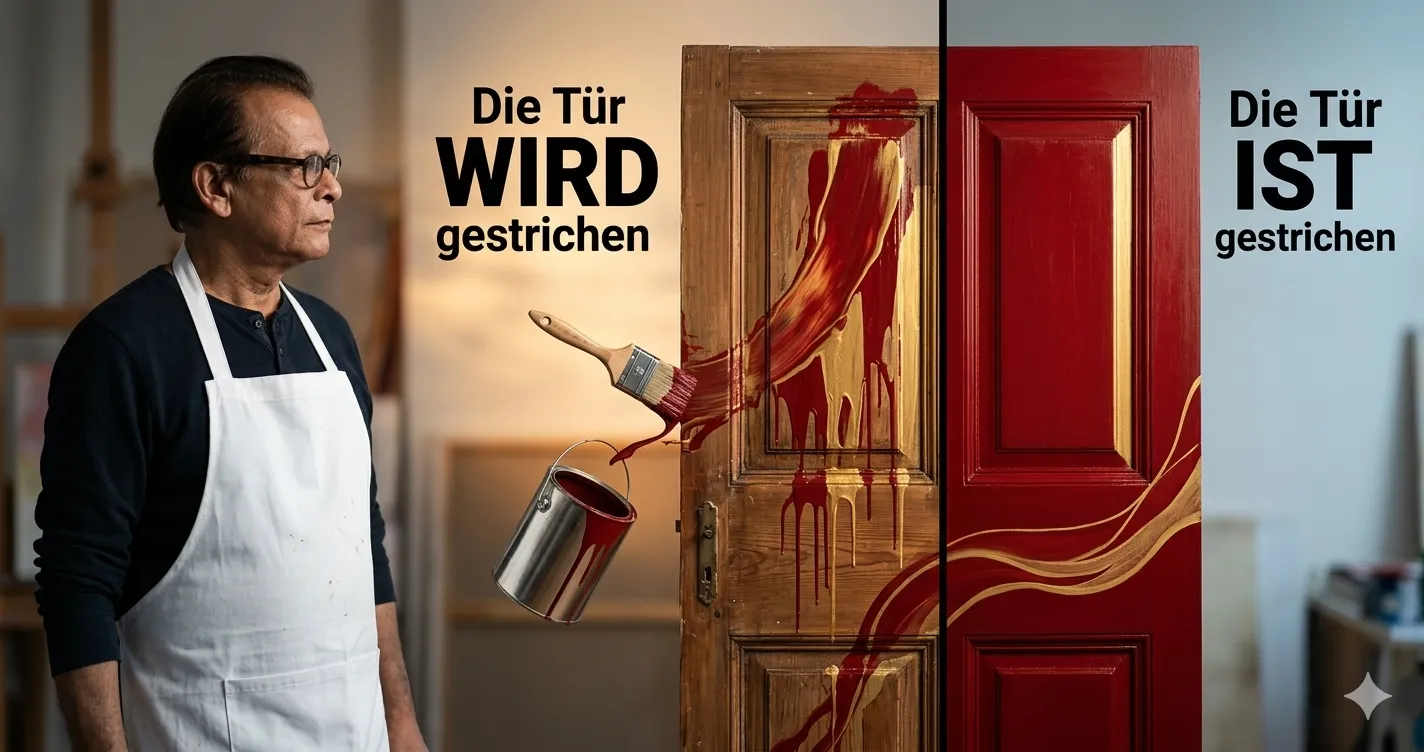
The passive voice (das Passiv) shifts the focus from who does the action to what happens. In English: "The book is read." In German: "Das Buch wird gelesen."
Passive is essential at B1 — it appears in news, instructions, scientific writing, and formal communication. This guide covers both German passives (Vorgangspassiv and Zustandspassiv), all tenses, modal passive, and the special transformations from active to passive.
The Two German Passives
- Vorgangspassiv (process passive) — describes the ACTION happening. Uses werden + past participle.
- Zustandspassiv (state passive) — describes the RESULT / state. Uses sein + past participle.
Compare:
- Die Tür wird geschlossen. — The door is being closed. (process)
- Die Tür ist geschlossen. — The door is closed. (state — already done)
Vorgangspassiv — The Active Action
Structure
werden (conjugated) + past participle (at end)
All Tenses
- Präsens: Das Haus wird gebaut. — The house is being built.
- Präteritum: Das Haus wurde gebaut. — The house was being built.
- Perfekt: Das Haus ist gebaut worden. — The house has been built.
- Plusquamperfekt: Das Haus war gebaut worden. — The house had been built.
- Futur I: Das Haus wird gebaut werden. — The house will be built.
Special Note: In Perfekt and Plusquamperfekt passive, the past participle of werden changes from geworden to worden. This is unique to passive — only happens here.
Werden Conjugation Recap
- Präsens: ich werde, du wirst, er wird, wir werden, ihr werdet, sie werden
- Präteritum: ich wurde, du wurdest, er wurde, wir wurden, ihr wurdet, sie wurden
Zustandspassiv — The Result State
Structure
sein (conjugated) + past participle
Used when the action is finished and we are looking at the resulting state.
- Das Geschäft ist geschlossen. — The shop is closed.
- Der Brief ist geschrieben. — The letter is written / done.
- Die Aufgabe war erledigt. — The task was completed (state).
Quick Test: Does the sentence describe an ongoing action or a completed state? Action → werden. State → sein.
From Active to Passive — The Transformation
Three steps:
- The Akkusativ object becomes the new subject.
- The verb becomes werden + past participle.
- The original subject becomes "von" + Dativ (only included if needed).
Examples:
- Active: Der Mann liest das Buch.
- Passive: Das Buch wird (vom Mann) gelesen.
- Active: Die Studenten lernten Deutsch.
- Passive: Deutsch wurde (von den Studenten) gelernt.
"Von" vs "Durch"
To name the agent (the doer):
- von + Dativ — for a personal/active agent: Das Auto wurde von einem Polizisten kontrolliert.
- durch + Akkusativ — for a means / cause: Das Haus wurde durch ein Erdbeben zerstört.
Modal Passive
Modal verb + werden + past participle. The past participle goes before werden at the end.
Pattern: modal (conjugated) + ... + past participle + werden (infinitive)
- Das Auto muss repariert werden. — The car must be repaired.
- Die Aufgabe kann heute gemacht werden. — The task can be done today.
- Hier darf nicht geraucht werden. — Smoking is not allowed here.
Passive Without an Agent (Most Common)
Often we do not name the agent — we just want to focus on the action:
- Hier wird Deutsch gesprochen. — German is spoken here.
- Das Brot wird frisch gebacken. — The bread is baked fresh.
- Die Türen werden um 22 Uhr geschlossen. — The doors are closed at 10 PM.
Passive with Dativ (Special Case)
Some verbs (helfen, danken, gefallen, gratulieren) only take Dativ. They CAN be made passive but the Dativ stays Dativ — the verb becomes impersonal:
- Active: Ich helfe dir.
- Passive: Dir wird geholfen. — You are being helped.
Or, with no real subject: Es wird mir geholfen. — I am being helped.
"Es"-Passive (No Subject Sentences)
Sometimes there is no real subject. German uses an empty es at the start:
- Es wird viel gefeiert. — There is a lot of celebrating.
- Es wurde laut diskutiert. — There was loud discussion.
If something else is in position 1, the es drops:
- Heute wird viel gefeiert.
- Gestern wurde laut diskutiert.
Common Mistakes to Avoid
Mistake 1: Forgetting "worden" in Perfekt passive
❌ Das Haus ist gebaut geworden.
✅ Das Haus ist gebaut worden.
Mistake 2: Confusing Vorgangspassiv with Zustandspassiv
❌ Die Tür ist geschlossen. (you mean it is being closed right now)
✅ Die Tür wird geschlossen.
Mistake 3: Using Akkusativ after "von"
❌ Das Buch wird von der Lehrer gelesen.
✅ Das Buch wird von dem Lehrer gelesen. (Dativ)
Mistake 4: Wrong word order in modal passive
❌ Das muss werden gemacht.
✅ Das muss gemacht werden.
When Native Speakers Avoid Passive
In casual conversation Germans often use "man" (one / someone) instead of passive:
- Passive: Hier wird viel gegessen.
- Active with "man": Hier isst man viel.
Both are correct. Passive is preferred in formal writing; "man" sounds more natural in speech.
Practice — Convert Active to Passive
- Active: Der Lehrer korrigiert die Aufgabe.
Passive: Die Aufgabe wird vom Lehrer korrigiert. - Active: Sie hat das Buch gelesen.
Passive: Das Buch ist von ihr gelesen worden. - Active: Wir müssen die Tür reparieren.
Passive: Die Tür muss repariert werden. - Active: Hier verkauft man frisches Brot.
Passive: Hier wird frisches Brot verkauft.
Summary
- Vorgangspassiv = werden + past participle (action happening).
- Zustandspassiv = sein + past participle (resulting state).
- In Perfekt passive, werden becomes worden (no ge-).
- Agent: von + Dativ (person), durch + Akkusativ (cause).
- Modal passive: modal + past participle + werden at end.
- "man" in active is often preferred in speech over passive.
Practice Tip: Take a short news article. Underline every passive sentence. For each, identify the tense and try to rewrite it active with "man". You will master both directions in two weeks.
Need structured passive-voice drills with corrections? GC Language Institute Lahore covers passive in B1 with daily writing exercises and Goethe B1 exam preparation.
Ready to Start Learning German?
Join GC Language Institute — Lahore's most trusted German academy.
Enroll Now