
How to Ask Questions in German: A Complete A1 Guide to W-Questions & Yes/No Questions
Learn how to form every kind of question in German — W-questions (wer, was, wo, wann, wie, warum), Yes/No questions, word order rules, and the daily-use phrases every A1 learner needs.
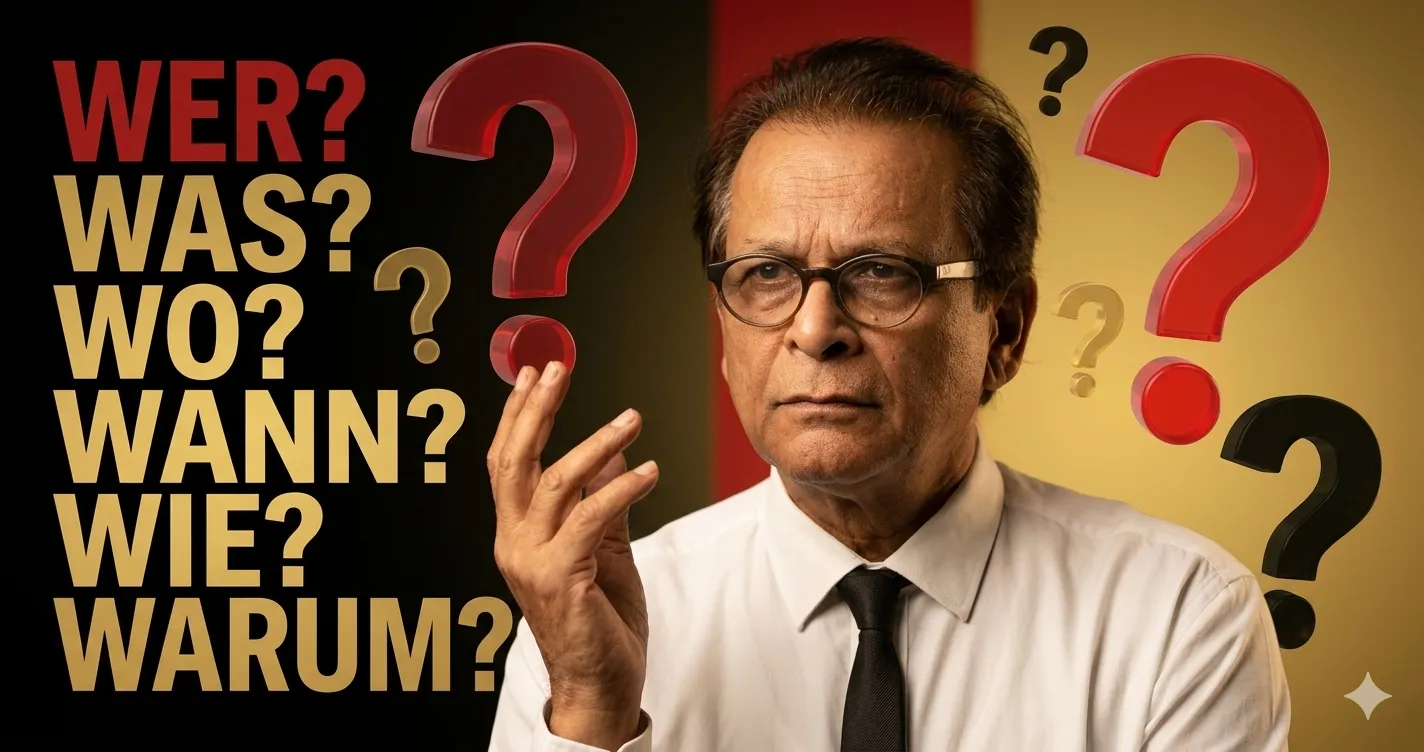
Asking questions is one of the very first skills you need in German — whether you are introducing yourself, asking for directions, or ordering food. The good news? German questions follow simple, predictable rules. Once you understand the two basic types and the word-order pattern, you can ask anything.
This guide covers everything: the two types of German questions, all the W-question words, word order, intonation, and the most useful daily-life examples for every A1 student.
The Two Types of German Questions
Every German question is one of two types:
- W-Questions (Open Questions) — they begin with a question word like was, wer, wo, wann. The answer is information.
- Yes/No Questions (Entscheidungsfragen) — they begin with the conjugated verb. The answer is Ja or Nein.
Golden Rule: In a W-question, the verb is always in position 2. In a Yes/No question, the verb is in position 1.
Yes/No Questions — Verb First
To form a Yes/No question, simply move the conjugated verb to the very front of the sentence.
Compare:
- Statement: Du sprichst Deutsch. — You speak German.
- Question: Sprichst du Deutsch? — Do you speak German?
More examples:
- Bist du Student? — Are you a student?
- Hast du Zeit? — Do you have time?
- Kommst du aus Pakistan? — Do you come from Pakistan?
- Kannst du mir helfen? — Can you help me?
- Wohnt ihr in Lahore? — Do you (pl.) live in Lahore?
Answering Yes/No Questions
- Ja — Yes
- Nein — No
- Doch — Yes (used to contradict a negative question, e.g. "Sprichst du kein Deutsch?" — "Doch!" = Yes, I do!)
W-Questions — Information Questions
W-questions begin with a question word (most start with the letter W). The conjugated verb stays in position 2.
Pattern: W-Word + Verb + Subject + Rest?
The Most Important W-Words
- Wer? — Who? (asks about a person, Nominativ)
- Was? — What? (asks about a thing or activity)
- Wo? — Where? (asks about a location — being there)
- Wohin? — Where to? (direction toward)
- Woher? — Where from? (origin)
- Wann? — When? (time)
- Wie? — How?
- Warum? — Why?
- Wie viel? / Wie viele? — How much? / How many?
- Welcher / Welche / Welches? — Which? (changes by gender)
- Was für (ein)? — What kind of?
Wer? — Who?
- Wer bist du? — Who are you?
- Wer ist das? — Who is that?
- Wer kommt morgen? — Who is coming tomorrow?
Was? — What?
- Was machst du? — What are you doing?
- Was ist das? — What is that?
- Was kostet das Buch? — What does the book cost?
Wo? / Wohin? / Woher?
- Wo wohnst du? — Where do you live? (Answer: In Lahore.)
- Wohin gehst du? — Where are you going (to)? (Answer: Nach Hause.)
- Woher kommst du? — Where are you from? (Answer: Aus Pakistan.)
Important difference: Wo = location (no movement). Wohin = direction toward. Woher = origin / where from. Mixing these up is one of the most common A1 mistakes.
Wann? — When?
- Wann beginnt der Kurs? — When does the course start?
- Wann hast du Geburtstag? — When is your birthday?
- Wann kommst du nach Hause? — When are you coming home?
Wie? — How?
- Wie heißt du? — What is your name? (literally: How are you called?)
- Wie geht es dir? — How are you?
- Wie alt bist du? — How old are you?
- Wie spät ist es? — What time is it?
Warum? — Why?
- Warum lernst du Deutsch? — Why are you learning German?
- Warum ist er müde? — Why is he tired?
Wie viel? / Wie viele?
- Wie viel kostet das? — How much does that cost? (uncountable / singular)
- Wie viele Studenten sind hier? — How many students are here? (countable plural)
Welcher / Welche / Welches?
Use the form that matches the gender of the noun:
- Welcher Mann ist dein Vater? (m)
- Welche Tasche ist deine? (f)
- Welches Buch liest du? (n)
- Welche Kinder sind hier? (pl)
Word Order — Master the Pattern
Pattern 1: Yes/No Question
Verb (Position 1) + Subject + Rest?
- Lernst du heute Deutsch?
- Hast du einen Bruder?
Pattern 2: W-Question
W-Word (Position 1) + Verb (Position 2) + Subject + Rest?
- Wo wohnst du?
- Was machst du heute?
Useful Daily-Life Questions to Memorize
- Wie heißen Sie? — What is your name? (formal)
- Woher kommen Sie? — Where are you from? (formal)
- Sprechen Sie Englisch? — Do you speak English?
- Wo ist die Toilette? — Where is the toilet?
- Was kostet das? — How much is this?
- Können Sie das wiederholen? — Can you repeat that?
- Wie spät ist es? — What time is it?
- Wo ist der Bahnhof? — Where is the train station?
- Haben Sie eine Speisekarte? — Do you have a menu?
- Können Sie mir helfen? — Can you help me?
Common Mistakes to Avoid
Mistake 1: Using English word order
❌ Du sprichst Deutsch? (rising intonation only — too casual / unclear)
✅ Sprichst du Deutsch?
Mistake 2: Mixing Wo / Wohin / Woher
❌ Wo gehst du?
✅ Wohin gehst du? (you are going somewhere — direction)
Mistake 3: Verb in wrong position in W-questions
❌ Wann du kommst?
✅ Wann kommst du?
Mistake 4: Forgetting "wie viele" for plural
❌ Wie viel Bücher hast du?
✅ Wie viele Bücher hast du?
Summary — What You Now Know
- Yes/No questions start with the verb in position 1.
- W-questions start with a W-word in position 1, verb in position 2.
- Master the W-words: wer, was, wo, wohin, woher, wann, wie, warum, wie viel(e), welcher.
- Use doch to give a positive answer to a negative question.
- Practice the daily-life phrases — they cover 80% of beginner conversations.
Pro Tip: Every day, try to ask yourself 3 W-questions about your daily routine in German. Within a week, question formation becomes second nature.
Want guided practice with native-style listening drills and speaking partners? GC Language Institute Lahore offers full A1 courses with certified instructors and conversation classes.
Ready to Start Learning German?
Join GC Language Institute — Lahore's most trusted German academy.
Enroll Now