
German Relative Pronouns and Conjunctions: A Complete B1 Guide to Connecting Sentences
Master German relative pronouns (der, die, das, dessen, dem, den) and all key conjunctions (weil, dass, wenn, obwohl, damit, trotzdem) — with rules, word order, and B1 examples.
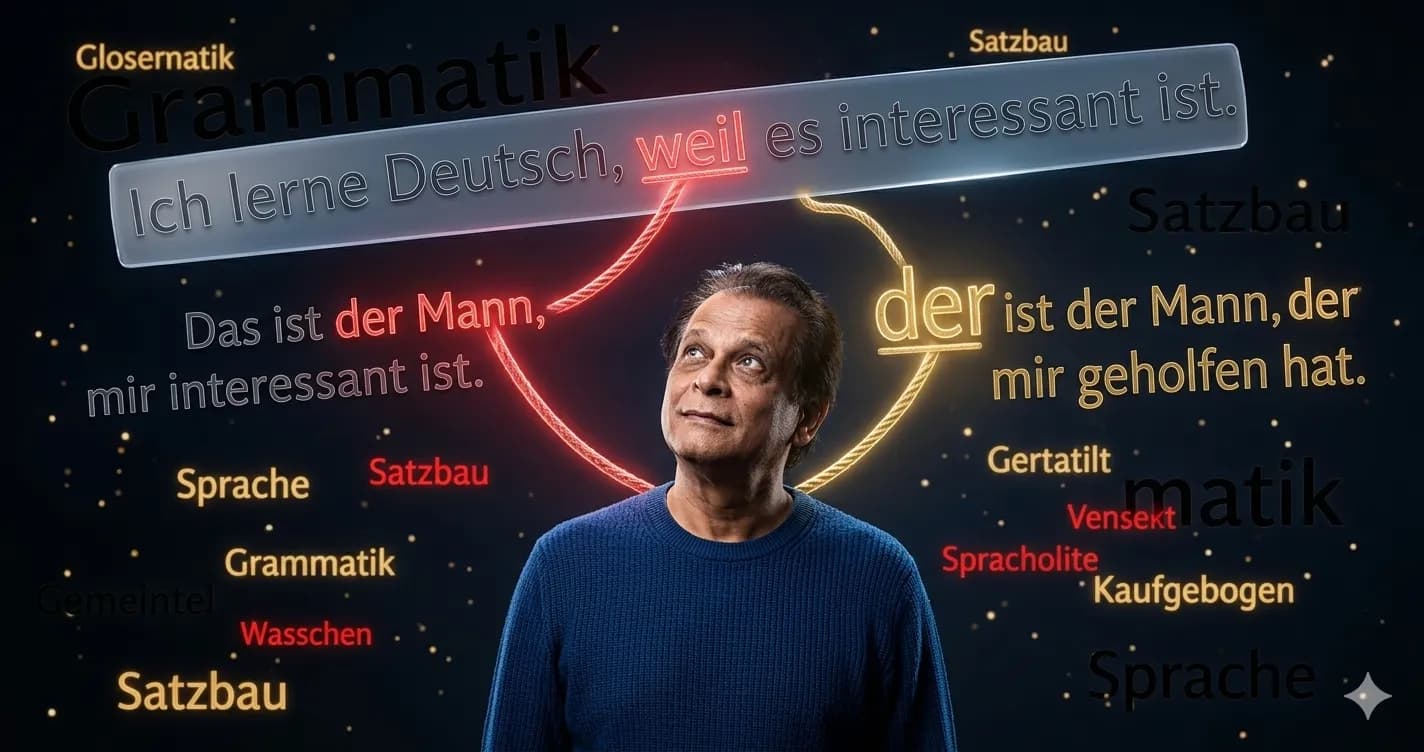
At B1, your sentences must grow up. Short A1/A2 sentences ("Ich lerne Deutsch. Es ist schwer.") become connected, complex thoughts ("Ich lerne Deutsch, weil ich in Deutschland studieren möchte, obwohl die Grammatik schwer ist."). The tools that make this happen are relative pronouns and conjunctions.
This guide covers both: how to combine sentences with relative clauses, and the full set of conjunctions you need at B1, with their exact word order rules.
Part 1: Relative Pronouns
A relative pronoun connects a sub-clause to a noun in the main sentence. It replaces a repeated noun and gives more information.
Example:
- Der Mann ist Lehrer. Der Mann wohnt in Berlin.
- Combined: Der Mann, der in Berlin wohnt, ist Lehrer.
Forms of Relative Pronouns
Relative pronouns look almost identical to definite articles, except for Dativ plural and Genitiv:
- m Nominativ: der
- f Nominativ: die
- n Nominativ: das
- pl Nominativ: die
- m Akkusativ: den
- f Akkusativ: die
- n Akkusativ: das
- pl Akkusativ: die
- m Dativ: dem
- f Dativ: der
- n Dativ: dem
- pl Dativ: denen (! special form)
- m Genitiv: dessen
- f Genitiv: deren
- n Genitiv: dessen
- pl Genitiv: deren
How to Choose the Right Form
Two-step rule:
- Gender / number → from the noun in the main clause.
- Case → from the role inside the relative clause.
Example: Der Mann, dem ich helfe, ist Lehrer.
- Gender: Mann (masculine)
- Case: helfen takes Dativ → dem
Word Order in a Relative Clause
The relative clause is a subordinate clause — the conjugated verb goes to the END.
- Das ist die Frau, die in Berlin wohnt.
- Das ist das Buch, das ich gestern gekauft habe.
- Das sind die Studenten, denen ich Deutsch beibringe.
Relative Clauses with Prepositions
If the relative pronoun needs a preposition, the preposition goes BEFORE the pronoun:
- Der Freund, mit dem ich Deutsch lerne, ist sehr nett.
- Die Stadt, in der ich wohne, ist Lahore.
- Das Geschenk, für das ich mich bedanke, ist toll.
Genitiv Relative — dessen / deren
Used to show possession (whose):
- Der Mann, dessen Auto kaputt ist, ärgert sich. — The man whose car is broken is annoyed.
- Die Frau, deren Kinder hier spielen, ist meine Nachbarin. — The woman whose children play here is my neighbour.
Part 2: Coordinating Conjunctions (Word Order Stays Normal)
These connectors join two main clauses. They do NOT change word order — the verb stays in position 2 in both clauses.
- und — and
- aber — but
- oder — or
- denn — because (giving a reason)
- sondern — but rather (after a negative)
Examples:
- Ich lerne Deutsch und ich höre Musik.
- Er ist müde, aber er arbeitet weiter.
- Wir kaufen das Buch, denn es ist interessant.
Part 3: Subordinating Conjunctions (Verb to the End)
These start a subordinate clause — and push the conjugated verb to the END of that clause. This is THE B1 rule that separates beginners from real intermediates.
The Big List
- weil — because
- dass — that
- wenn — when / if
- als — when (one-time event in past)
- ob — whether / if (yes-no embedded question)
- obwohl — although
- damit — so that (purpose)
- bevor — before
- nachdem — after
- während — while / during
- seit / seitdem — since
- solange — as long as
- sobald — as soon as
- bis — until
- falls — in case
Word Order Examples
- Ich lerne Deutsch, weil ich in Deutschland studieren möchte.
- Er sagt, dass er morgen kommt.
- Wenn ich Zeit habe, lese ich.
- Ich war glücklich, als ich das Stipendium bekam.
- Sie geht zur Arbeit, obwohl sie krank ist.
Big Difference: Wenn = if / whenever (general or future); als = when (one specific past event). Ich war glücklich, als ich gewann. ✓ Ich war glücklich, wenn ich gewann. = whenever I won.
The "Front-Loaded" Pattern
You can put the subordinate clause FIRST. Then the main clause begins with the verb in position 1 of what is left:
- Weil ich krank bin, bleibe ich zu Hause.
- Wenn es regnet, nehme ich einen Schirm.
Pattern: comma + verb + subject (the "verb-comma-verb" sandwich is a B1 signature).
Part 4: Conjunctional Adverbs (Verb at Position 2 But After the Adverb)
These work differently — they go at the START of a sentence, then the verb comes second:
- trotzdem — nevertheless
- deshalb / deswegen — therefore
- außerdem — besides / moreover
- dann — then
- danach — afterwards
- sonst — otherwise
- also — so / therefore
Examples:
- Es regnet. Trotzdem gehe ich spazieren.
- Ich bin krank. Deshalb bleibe ich zu Hause.
- Wir essen zuerst. Danach gehen wir ins Kino.
Trap: Trotzdem looks like obwohl but uses NORMAL word order, not subordinate. Obwohl ich müde bin, gehe ich. = Ich bin müde. Trotzdem gehe ich.
Common Mistakes to Avoid
Mistake 1: Forgetting verb at the end after weil/dass
❌ Ich bleibe zu Hause, weil ich bin krank.
✅ Ich bleibe zu Hause, weil ich krank bin.
Mistake 2: Using "wenn" instead of "als" for a one-time past event
❌ Wenn ich in Berlin war, regnete es. (sounds like "every time I was in Berlin")
✅ Als ich in Berlin war, regnete es.
Mistake 3: Wrong relative pronoun case
❌ Der Mann, der ich helfe, ist alt.
✅ Der Mann, dem ich helfe, ist alt. (helfen → Dativ)
Mistake 4: Forgetting verb-second after a fronted subordinate clause
❌ Wenn es regnet, ich nehme einen Schirm.
✅ Wenn es regnet, nehme ich einen Schirm.
Practice Sentences
- "The book that I read is interesting." → Das Buch, das ich lese, ist interessant.
- "I am learning German because I want to study in Germany." → Ich lerne Deutsch, weil ich in Deutschland studieren will.
- "Although it is raining, we are going for a walk." → Obwohl es regnet, gehen wir spazieren.
- "I do not know if she is coming." → Ich weiß nicht, ob sie kommt.
- "The friend with whom I learn is nice." → Der Freund, mit dem ich lerne, ist nett.
Summary
- Relative pronouns: choose gender/number from the noun, case from the role inside the relative clause.
- Coordinating conjunctions (und, aber, oder, denn, sondern) — verb stays in position 2.
- Subordinating conjunctions (weil, dass, wenn, als, obwohl, damit ...) — verb to the END.
- Conjunctional adverbs (trotzdem, deshalb, dann ...) — verb-second after the adverb.
- Wenn = general / future; als = one past event.
Practice Path: Pick five subordinating conjunctions. Each day, write two sentences with each. After two weeks, B1 sentence structure becomes second nature.
At GC Language Institute Lahore, every B1 course includes daily writing practice with full corrections — connect your sentences like a native.
Ready to Start Learning German?
Join GC Language Institute — Lahore's most trusted German academy.
Enroll Now