
Spoken German for B1: How to Sound Fluent — Connectors, Filler Words, and Real Conversation Strategies
Stop sounding like a textbook. Learn how Germans actually speak — connectors, filler words, casual phrases, intonation, and the speaking strategies B1 learners need to sound natural.
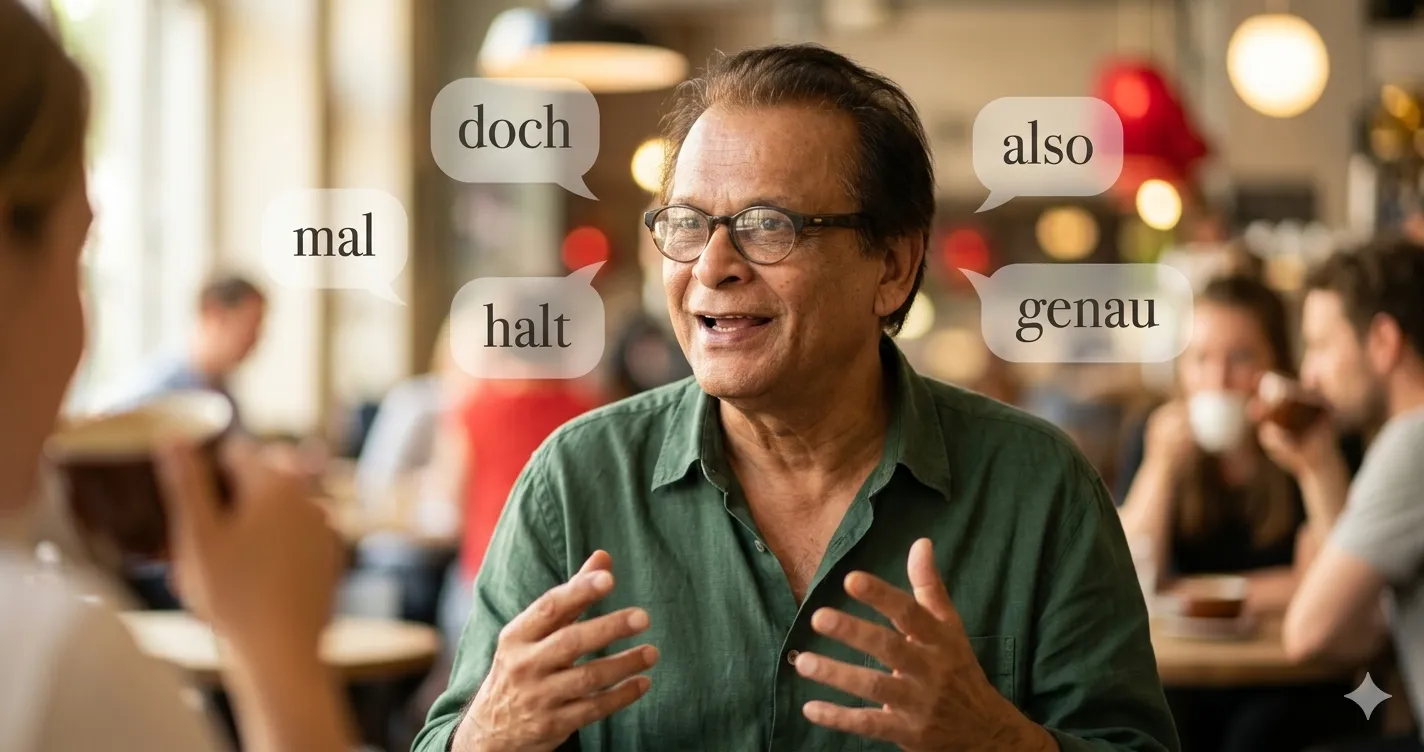
You can have perfect grammar and still sound stiff and "robotic" in German. Real native speakers use filler words, connectors, intonation, and casual phrases that no textbook teaches. This is the difference between B1 grammar and B1 fluency — and it is what this guide focuses on.
Read it carefully and apply just three of these tips daily. In one month, your spoken German will sound noticeably more natural.
What Spoken German Really Sounds Like
Native German has features the books rarely mention:
- Filler words — "naja", "äh", "also", "halt", "eben"
- Sentence starters — "Mensch...", "Ehrlich gesagt...", "Eigentlich..."
- Casual contractions — "haste" (hast du), "kannste" (kannst du), "geht's" (geht es)
- Quick connectors — und dann, also, ja, weißt du
- Modal particles — "doch", "mal", "ja", "halt", "denn"
The Magic Modal Particles
Modal particles are tiny words that change the tone of a sentence. They are HARD to translate, but every native speaker uses them constantly.
doch
Adds emphasis or contradiction.
- Komm doch mit! — Come on, come along!
- Das ist doch klar. — Of course that is clear.
mal
Softens a request.
- Komm mal her. — Come over here, will you.
- Schau mal! — Look here!
ja
States the obvious / shared knowledge.
- Du weißt ja, dass ich krank bin. — You know I am sick (we both know this).
halt / eben
"Just" — accepting a fact.
- So ist es halt. — That is just how it is.
denn
Softens a question.
- Was machst du denn? — So, what are you doing? (more curious / friendly)
Pro Tip: Pick ONE modal particle per week. Use it 10+ times daily. After 5 weeks you have all 5 in your active speech and sound dramatically more native.
Filler Words That Buy You Time
Native speakers use filler words to think — never silent pauses. Use these:
- also — well / so
- naja — well
- äh / ähm — uh / um (yes, in German too)
- weißt du — you know
- genau — exactly / right
- sozusagen — so to speak
- im Prinzip — in principle
- das heißt — that is to say
Useful Sentence Starters
- Ehrlich gesagt, ... — Honestly, ...
- Meiner Meinung nach, ... — In my opinion, ...
- Ich finde, dass ... — I think that ...
- Eigentlich ... — Actually ...
- Übrigens, ... — By the way, ...
- Auf der einen Seite ... auf der anderen Seite ... — On one hand ... on the other hand ...
- Zum Beispiel ... — For example ...
The 5 Strategies for Better Speaking
Strategy 1: Repeat What You Hear
When a German speaks to you, repeat their last 2–3 words at the start of your reply. It buys time and sounds natural:
- Native: "Ich war gestern in München."
- You: "In München, ach so. Was hast du dort gemacht?"
Strategy 2: Speak in Short Chunks
Long, complex sentences trip you up. Speak in 5–7 word chunks. Use connectors to chain them.
- Avoid: "Obwohl ich heute eigentlich keine Zeit hatte, weil ich viel arbeiten musste, bin ich trotzdem zu meiner Freundin gegangen ..."
- Prefer: "Heute hatte ich eigentlich keine Zeit. Aber dann bin ich trotzdem zu meiner Freundin gegangen."
Strategy 3: Use Konjunktiv II for Politeness
K2 makes you sound mature. Replace direct forms with K2:
- Instead of "Ich will" → "Ich möchte / ich hätte gern"
- Instead of "Kannst du?" → "Könntest du?"
- Instead of "Soll ich?" → "Sollte ich?"
Strategy 4: Master Five Connectors
Native speakers chain ideas with these five tiny words. Master them:
- also — so / well
- aber — but
- trotzdem — nevertheless
- deshalb — therefore
- zum Beispiel — for example
String them together: "Also, ich bin müde, aber ich muss arbeiten. Trotzdem habe ich Zeit für dich. Deshalb können wir uns treffen, zum Beispiel um 17 Uhr."
Strategy 5: Listen + Mimic
Pick a German YouTuber, podcaster, or actor whose voice you like. Listen and copy their rhythm, intonation, and speed. This is shadowing — and it is the single fastest way to sound native.
Useful Daily Conversation Phrases
Reacting
- Ach so! — Oh, I see!
- Genau! — Exactly!
- Stimmt. — True.
- Wirklich? — Really?
- Echt? — For real?
- Wow, das ist toll! — Wow, that is great!
- Schade. — Too bad.
- Verstehe. — I understand.
Buying Time
- Hmm, lass mich kurz nachdenken. — Hmm, let me think briefly.
- Wie soll ich das sagen ... — How should I say this ...
- Das ist eine gute Frage. — That is a good question.
- Moment mal. — One moment.
Continuing a Story
- Und dann ... — And then ...
- Plötzlich ... — Suddenly ...
- Und das war noch nicht alles. — And that was not all.
Expressing Opinion
- Ich glaube ... — I believe ...
- Ich denke ... — I think ...
- Meiner Meinung nach ... — In my opinion ...
- Es kommt darauf an. — It depends.
Goethe B1 Sprechen — What to Expect
The Goethe B1 oral exam has three parts:
- Personal interview — basic Q&A about you, your life, your family.
- Planning together — you and a partner plan an event (a trip, a birthday, etc.).
- Presentation — give a 3–5 minute talk on a topic, then field follow-up questions.
Strategies
- Use K2 for proposals: "Wir könnten ... / Wir sollten ..."
- Use connectors: also, deshalb, zum Beispiel, andererseits
- Always express an opinion: "Ich finde, dass ..."
- Ask the partner questions: "Was meinst du dazu?"
- If stuck, paraphrase — never freeze in silence.
Common Mistakes Pakistani Learners Make
- Translating from Urdu/English in real time — kills speed. Practice "thinking in German" with daily monologues.
- Using "ich will" all the time — sounds rude. Default to "ich möchte".
- Pronouncing "ch" as "sh" — ich ≠ "ish". Practice ich, dich, mich properly.
- Stopping when you make a mistake — keep going. Native speakers also self-correct.
- Ignoring intonation — German questions rise at the end; statements fall.
30-Day Speaking Improvement Plan
- Days 1–10: Pick 5 modal particles + 5 filler words. Use them daily in monologues.
- Days 11–20: Shadow a 2-minute German YouTube clip every day.
- Days 21–30: Have a 5-minute conversation in German every day — language partner, tutor, or just yourself.
Summary
- Spoken German uses modal particles, filler words, sentence starters.
- Master doch, mal, ja, halt, denn — they make you sound native.
- Use K2 for politeness in every social interaction.
- Speak in short chunks connected with also, aber, trotzdem, deshalb.
- Mimicry / shadowing is the fastest way to fluency.
- For Goethe B1 oral, propose with K2 and always express an opinion.
The Truth About Speaking: Fluency is not knowing more grammar. It is using less grammar more often. Master 100 useful phrases and 5 connectors — that beats 1000 advanced grammar rules.
Practice spoken B1 with native-pace speaking sessions, role plays, and Goethe oral exam simulation at GC Language Institute Lahore — the most trusted German academy in Pakistan.
Ready to Start Learning German?
Join GC Language Institute — Lahore's most trusted German academy.
Enroll Now