
German Verb Conjugation for Beginners: A Complete A1 Guide with Rules & Examples
Learn how to conjugate German verbs from zero — regular verbs, irregular verbs, sein, haben, werden, separable verbs, and the present tense rules every A1 learner needs in one full guide.
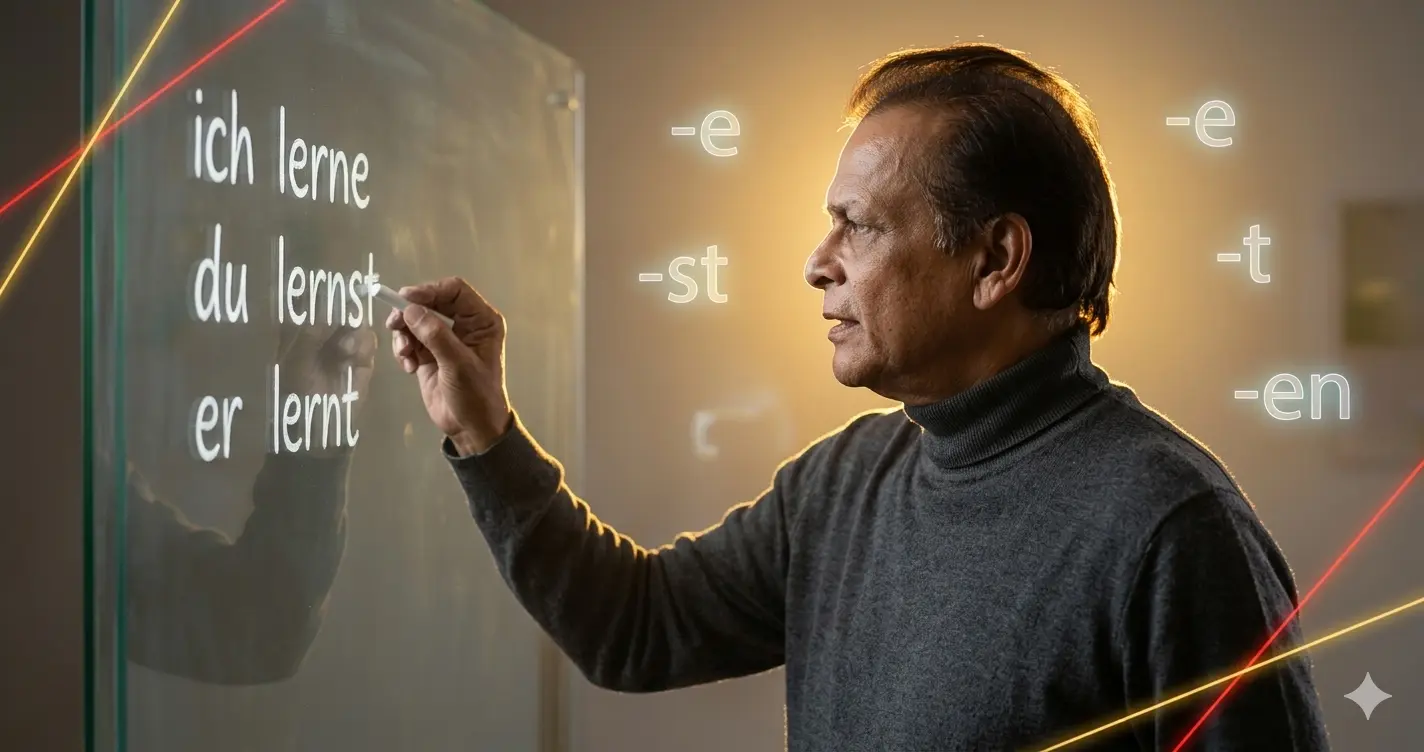
Verbs are the engine of every German sentence. If the noun tells you who, the verb tells you what is happening — and unlike English, German verbs change form depending on who is doing the action. This is called conjugation, and mastering it at A1 is non-negotiable.
This guide covers everything an A1 student needs: how regular verbs work, the most important irregular verbs, separable verbs, the verbs sein, haben, and werden, and the patterns you must memorize before moving to A2.
What Is Verb Conjugation?
Conjugation means changing the verb ending so it matches the subject (the person doing the action). Every German verb has an infinitive form (the dictionary form) ending in -en or -n.
- lernen — to learn
- spielen — to play
- kommen — to come
- wandern — to hike (ends in -n only)
To conjugate a verb, remove the -en to find the stem, then add a new ending for each pronoun.
Formula: Stem + personal ending = conjugated verb. lernen → lern- + e/st/t/en/t/en
Regular Verbs in the Present Tense
Regular verbs follow a fixed pattern. Take the verb lernen (to learn):
- ich lerne — I learn
- du lernst — you learn (informal)
- er / sie / es lernt — he / she / it learns
- wir lernen — we learn
- ihr lernt — you all learn
- sie / Sie lernen — they / you (formal) learn
The same endings apply to almost every regular verb:
spielen (to play)
- ich spiele, du spielst, er spielt, wir spielen, ihr spielt, sie spielen
wohnen (to live / reside)
- ich wohne, du wohnst, er wohnt, wir wohnen, ihr wohnt, sie wohnen
kaufen (to buy)
- ich kaufe, du kaufst, er kauft, wir kaufen, ihr kauft, sie kaufen
Memorize the endings: -e, -st, -t, -en, -t, -en. This pattern unlocks 80% of all German verbs.
Special Spelling Rules
Rule 1: Stems ending in -t, -d, -n, or -m
If the verb stem ends in -t, -d, -n, or -m (after a consonant), insert an extra -e- before the ending for du, er/sie/es, and ihr — to make pronunciation easier.
Example: arbeiten (to work)
- ich arbeite, du arbeitest, er arbeitet, wir arbeiten, ihr arbeitet, sie arbeiten
Example: finden (to find)
- ich finde, du findest, er findet, wir finden, ihr findet, sie finden
Rule 2: Stems ending in -s, -ß, -z, or -x
If the stem ends in an s-sound, drop the extra -s in the du form.
Example: heißen (to be called)
- ich heiße, du heißt (not heißst!), er heißt, wir heißen, ihr heißt, sie heißen
Example: tanzen (to dance)
- ich tanze, du tanzt, er tanzt, wir tanzen, ihr tanzt, sie tanzen
Irregular Verbs (Stem-Changing Verbs)
Some common verbs change their stem vowel in the du and er/sie/es forms. The endings stay the same — only the vowel changes. There are three main groups:
Group 1: a → ä
fahren (to drive / go)
- ich fahre, du fährst, er fährt, wir fahren, ihr fahrt, sie fahren
Other a → ä verbs: schlafen (to sleep), tragen (to wear), laufen (to run), halten (to hold).
Group 2: e → i
sprechen (to speak)
- ich spreche, du sprichst, er spricht, wir sprechen, ihr sprecht, sie sprechen
Other e → i verbs: essen (to eat), geben (to give), helfen (to help), nehmen (to take).
Group 3: e → ie
lesen (to read)
- ich lese, du liest, er liest, wir lesen, ihr lest, sie lesen
Other e → ie verbs: sehen (to see), empfehlen (to recommend).
Important: The vowel change only happens in du and er/sie/es. The ich, wir, ihr, sie forms stay normal.
The Three Most Important Irregular Verbs
Memorize these three verbs first — you will use them in every conversation.
sein (to be)
- ich bin
- du bist
- er / sie / es ist
- wir sind
- ihr seid
- sie / Sie sind
Examples: Ich bin Student. (I am a student.) / Wir sind aus Pakistan. (We are from Pakistan.)
haben (to have)
- ich habe
- du hast
- er / sie / es hat
- wir haben
- ihr habt
- sie / Sie haben
Examples: Ich habe einen Bruder. (I have a brother.) / Sie hat zwei Kinder. (She has two children.)
werden (to become)
- ich werde
- du wirst
- er / sie / es wird
- wir werden
- ihr werdet
- sie / Sie werden
Examples: Ich werde Lehrer. (I am becoming a teacher.) / Es wird kalt. (It is getting cold.)
Separable Verbs
Many German verbs have a separable prefix that detaches and moves to the end of the sentence when conjugated.
Common separable prefixes: auf-, ab-, an-, aus-, ein-, mit-, nach-, vor-, zu-
Example: aufstehen (to get up)
- Ich stehe um 7 Uhr auf. — I get up at 7 o clock.
- Wann stehst du auf? — When do you get up?
Example: einkaufen (to shop / buy groceries)
- Wir kaufen samstags ein. — We shop on Saturdays.
Other common separable verbs: anrufen (to call), mitkommen (to come along), fernsehen (to watch TV), aufmachen (to open), zumachen (to close).
Rule: In a normal main-clause sentence, the conjugated part of the verb is in position 2, and the separable prefix goes to the very end.
Modal Verbs — A Quick Preview
Modal verbs (können, müssen, wollen, sollen, dürfen, mögen) are also irregular and have their own special pattern. They get their own dedicated A1 lesson, but here is the short version of können (can):
- ich kann, du kannst, er kann, wir können, ihr könnt, sie können
Notice that ich and er/sie/es have the same form — that is the unique signature of modal verbs.
How to Build a Sentence with a Conjugated Verb
The basic German word order in a statement is:
- Position 1: Subject (or another element)
- Position 2: Conjugated verb (always!)
- Position 3+: Other information
Examples:
- Ich lerne jeden Tag Deutsch. — I learn German every day.
- Heute lerne ich Deutsch. — Today I learn German. (Subject moves to position 3 because the time word takes position 1, but the verb stays in position 2.)
The Golden Rule of A1 word order: The conjugated verb is always in position 2 in a statement. Always. Never move it.
Common Mistakes to Avoid
Mistake 1: Using the infinitive instead of conjugating
❌ Ich lernen Deutsch.
✅ Ich lerne Deutsch.
Mistake 2: Forgetting the vowel change
❌ Du sprechst Deutsch.
✅ Du sprichst Deutsch.
Mistake 3: Wrong word order
❌ Heute ich lerne Deutsch.
✅ Heute lerne ich Deutsch.
Mistake 4: Forgetting the separable prefix
❌ Ich aufstehe um 7 Uhr.
✅ Ich stehe um 7 Uhr auf.
Practice Examples
Conjugate the verb in your head before reading the answer:
- (spielen — wir) → Wir spielen Fußball.
- (arbeiten — du) → Du arbeitest viel.
- (sprechen — er) → Er spricht Deutsch.
- (haben — ich) → Ich habe Hunger.
- (sein — ihr) → Ihr seid nett.
- (aufstehen — sie/she) → Sie steht früh auf.
Summary — Everything You Now Know
- Every German verb has an infinitive ending in -en or -n.
- Regular endings: -e, -st, -t, -en, -t, -en.
- Stems ending in -t, -d, -n, -m → add an -e- for du, er/sie/es, ihr.
- Some verbs change their stem vowel in du and er/sie/es (a→ä, e→i, e→ie).
- Memorize sein, haben, werden by heart.
- Separable verbs split: prefix goes to the end of the sentence.
- The conjugated verb is always in position 2 in a main clause.
Next Step: Practice conjugating 5 new verbs every day. After two weeks, regular conjugation will become automatic — and that is the foundation everything else builds on.
Want guided A1 classes with daily verb practice and personal feedback? GC Language Institute Lahore offers structured German courses A1 to C2 with certified instructors. Get in touch and start your German journey the right way.
Ready to Start Learning German?
Join GC Language Institute — Lahore's most trusted German academy.
Enroll Now