
Konjunktiv II (K2) in German: A Complete A–Z Guide with Rules, Examples & Daily-Use Sentences
Master German Konjunktiv II (K2) with this complete A–Z guide. Learn all rules, conjugations, würde-form, polite requests, wishes, and 10 daily-use examples — perfect for B1, B2 & Goethe-Zertifikat learners.
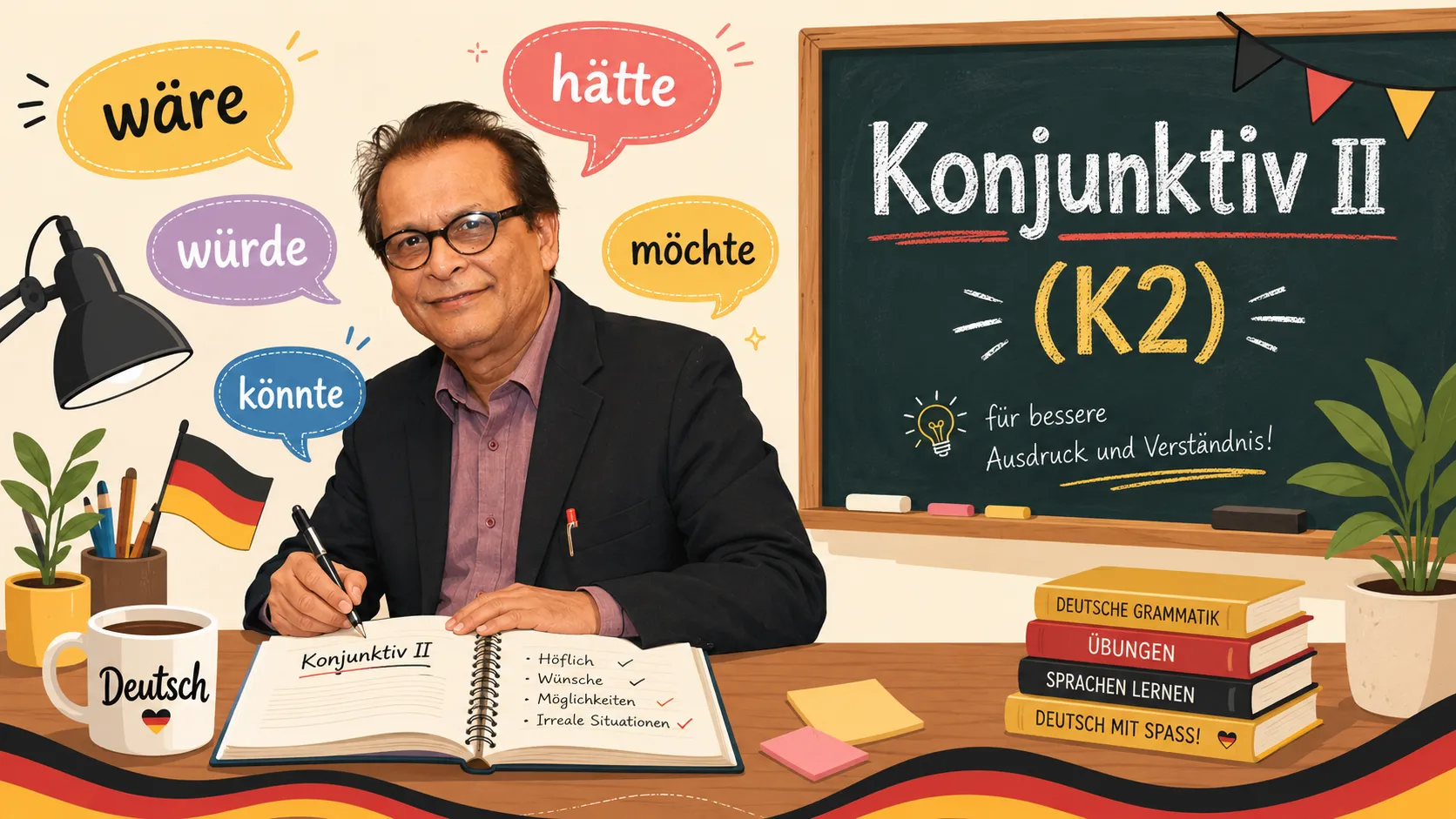
If you've ever wanted to say "I would travel the world," "Could you please help me?" or "If I were rich…" in German — congratulations, you've already met Konjunktiv II.
Konjunktiv II (often called K2 or the General Subjunctive) is the German verb mood used for everything that is not real, not yet, or just polite — wishes, dreams, hypothetical "what-if" situations, advice, and polite requests.
Many learners panic when they hear the word Konjunktiv, but the truth is: you only need to memorize a small set of forms (mainly wäre, hätte, würde, and the modal verbs), and you can already speak natural, polite, and elegant German.
By the end of this guide, you will know:
What Konjunktiv II is and why Germans use it daily
How to form it (with full conjugation tables)
The famous würde + Infinitiv construction
When to use the original form vs. the würde-form
How to talk about the past in K2
10 daily-use examples, from beginner to advanced
Common mistakes and how to avoid them
Let's begin. 🇩🇪
1. What Is Konjunktiv II?
In German, every verb has three moods:
① Indikativ (Indicative)
Purpose: Real facts
Example: Ich habe Zeit. — I have time.
② Imperativ (Imperative)
Purpose: Commands
Example: Hab Zeit! — Have time!
③ Konjunktiv (Subjunctive)
Purpose: Unreal, polite, reported speech
Example: Ich hätte Zeit. — I would have time.
Konjunktiv has two types: Konjunktiv I (used for reported speech in news/journalism) and Konjunktiv II (used in everyday life).
👉 Simple definition
Konjunktiv II = the verb form Germans use when something is NOT a fact — it's imagined, polite, wished for, or hypothetical.
The closest English equivalent is "would, could, should, would have, could have."
2. Why Konjunktiv II Is So Important
Without K2, your German sounds rude, robotic, and too direct. Compare:
❌ Too direct: Ich will einen Kaffee. (I want a coffee.)
✅ Polite: Ich hätte gern einen Kaffee. (I'd like a coffee.)
❌ Too direct: Kannst du mir helfen? (Can you help me?)
✅ Polite: Könntest du mir helfen? (Could you help me?)
❌ Too direct: Gib mir das Buch. (Give me the book.)
✅ Polite: Würdest du mir bitte das Buch geben? (Would you please give me the book?)
This is why Konjunktiv II is a must-know for anyone working, studying, or living in Germany, Austria, or Switzerland.
3. The 5 Main Uses of Konjunktiv II
① Polite Requests (Höfliche Bitten)
Könnten Sie das bitte wiederholen? — Could you please repeat that?
Würdest du mir bitte helfen? — Would you please help me?
② Wishes (Wünsche)
Ich wünschte, ich wäre jetzt im Urlaub. — I wish I were on vacation now.
Wenn ich nur mehr Geld hätte! — If only I had more money!
③ Hypothetical / Unreal Situations (Irreale Bedingungen)
Wenn ich reich wäre, würde ich um die Welt reisen. — If I were rich, I would travel around the world.
Wenn ich Zeit hätte, würde ich dich besuchen. — If I had time, I would visit you.
④ Advice & Suggestions (Ratschläge)
Du solltest mehr schlafen. — You should sleep more.
An deiner Stelle würde ich zum Arzt gehen. — In your place, I'd go to the doctor.
⑤ Unreal Comparisons with als ob / als wenn
Er tut so, als ob er alles wüsste. — He acts as if he knew everything.
Sie spricht, als wäre sie eine Königin. — She speaks as if she were a queen.
4. How to Form Konjunktiv II — The Two Routes
There are two ways to form K2, and you need both:
Route A — Original (one-word) form
Formula: Past stem + umlaut + endings
When to use: For sein, haben, werden, modal verbs, and a few common strong verbs.
Route B — Würde-form
Formula: würde + Infinitiv
When to use: For regular verbs and most other strong verbs (especially in spoken German).
Why two forms?
Because for regular (weak) verbs, the K2 form looks exactly the same as the simple past (Präteritum):
Ich machte → could mean "I made" OR "I would make" 😱
To avoid confusion, Germans use würde + Infinitiv for weak verbs:
Ich würde machen — clearly means "I would make" ✅
5. The Three "Champions" of Konjunktiv II: sein, haben, werden
These three verbs are the backbone of K2. Memorize them first.
sein → wäre (would be)
ich — wäre (I would be)
du — wärst / wärest (you would be)
er / sie / es — wäre (he/she/it would be)
wir — wären (we would be)
ihr — wärt / wäret (you all would be)
sie / Sie — wären (they / you formal would be)
Examples:
Ich wäre gern reich. — I would like to be rich.
Wenn er hier wäre, … — If he were here, …
haben → hätte (would have)
ich — hätte (I would have)
du — hättest (you would have)
er / sie / es — hätte (he/she/it would have)
wir — hätten (we would have)
ihr — hättet (you all would have)
sie / Sie — hätten (they / you formal would have)
Examples:
Ich hätte gern einen Tee. — I'd like a tea.
Wenn ich Zeit hätte, … — If I had time, …
werden → würde (would)
ich — würde (I would)
du — würdest (you would)
er / sie / es — würde (he/she/it would)
wir — würden (we would)
ihr — würdet (you all would)
sie / Sie — würden (they / you formal would)
Examples:
Ich würde gern nach Berlin reisen. — I'd like to travel to Berlin.
Würden Sie mir bitte helfen? — Would you please help me?
6. Modal Verbs in Konjunktiv II
Modal verbs in K2 are extremely common. Notice that sollen and wollen do not take an umlaut.
✦ können → könnte (could)
✦ müssen → müsste (would have to)
✦ dürfen → dürfte (would be allowed to / might)
✦ sollen → sollte (should)
✦ wollen → wollte (would want)
✦ mögen → möchte (would like)
⚠️ Note: sollen and wollen do NOT take an umlaut.
Full conjugation of können (could):
ich — könnte
du — könntest
er / sie / es — könnte
wir — könnten
ihr — könntet
sie / Sie — könnten
Examples:
✦ Könntest du mir bitte helfen? — Could you please help me?
✦ Wir sollten jetzt gehen. — We should go now.
✦ Ich möchte einen Kaffee, bitte. — I'd like a coffee, please.
7. Strong (Irregular) Verbs in Konjunktiv II
For strong verbs, take the Präteritum stem and add an umlaut (if the vowel is a, o, or u) plus K2 endings.
✦ gehen → ging → ginge (would go)
✦ kommen → kam → käme (would come)
✦ geben → gab → gäbe (would give)
✦ finden → fand → fände (would find)
✦ sehen → sah → sähe (would see)
✦ nehmen → nahm → nähme (would take)
✦ bleiben → blieb → bliebe (would stay)
✦ wissen → wusste → wüsste (would know)
💡 Tip: Most of these original forms sound a bit literary nowadays. Native speakers often replace them with würde + Infinitiv — except for wüsste, käme, and gäbe, which still sound natural.
8. Regular (Weak) Verbs in Konjunktiv II → Always Use würde
For all regular verbs (machen, arbeiten, lernen, kaufen, spielen…), the original K2 form looks identical to the Präteritum, so we always use würde + Infinitiv.
✦ ich würde + machen → Ich würde das nicht machen.
✦ du würdest + arbeiten → Du würdest mehr arbeiten.
✦ er / sie / es würde + lernen → Sie würde Deutsch lernen.
✦ wir würden + kaufen → Wir würden ein Auto kaufen.
✦ ihr würdet + spielen → Ihr würdet Fußball spielen.
✦ sie / Sie würden + reisen → Sie würden nach Italien reisen.
9. Original Form vs. Würde-Form — Which One to Choose?
This is the question every learner asks. Here's the simple rule:
① For sein, haben: Use original form.
Example: Ich wäre froh. / Ich hätte Zeit.
② For modal verbs: Use original form.
Example: Du solltest gehen.
③ For common strong verbs (wissen, kommen, geben): Original is fine.
Example: Ich wüsste die Antwort.
④ For all regular verbs: ALWAYS use würde + Infinitiv.
Example: Ich würde mehr lernen.
⑤ For less common strong verbs: würde + Infinitiv sounds more natural.
Example: Ich würde das schreiben.
✅ Quick rule of thumb: When in doubt, use würde + Infinitiv. Native speakers will understand you 100%.
10. Konjunktiv II in the Past Tense
To talk about something that didn't happen in the past ("would have / could have / should have"), use:
hätte / wäre + Partizip II
Use hätte for most verbs.
Use wäre for verbs of motion or change of state (gehen, kommen, fahren, werden, sein…).
✦ Ich hätte das gemacht. — I would have done that.
✦ Wenn du gefragt hättest, hätte ich dir geholfen. — If you had asked, I would have helped you.
✦ Er wäre fast gestorben. — He would have almost died.
✦ Wir wären gerne gekommen. — We would have liked to come.
✦ Du hättest mehr lernen sollen. — You should have studied more.
⚠️⚠️ Important: Past K2 with modal verbs uses a double infinitive:
✦ Ich hätte das machen können. — I could have done that.
✦ Du hättest mehr lernen müssen. — You would have had to study more.
11. The Famous "Wenn… dann…" Sentences (Conditional Sentences)
This is where K2 truly shines. The structure:
Wenn + Konjunktiv II, (dann) + würde / Konjunktiv II
✦ Wenn ich Zeit hätte, würde ich dich besuchen.
If I had time, I would visit you.
✦ Wenn ich reich wäre, würde ich ein Haus kaufen.
If I were rich, I would buy a house.
✦ Wenn ich besser Deutsch sprechen könnte, würde ich in Berlin arbeiten.
If I could speak German better, I would work in Berlin.
✦ Wenn er früher aufgestanden wäre, hätte er den Zug erreicht.
If he had gotten up earlier, he would have caught the train.
💡 You can also flip it without wenn: Hätte ich Zeit, würde ich dich besuchen.
12. 🌟 10 Daily-Use Examples with würde — From Simple to Complex
Here are 10 sentences you can actually use today, ranked from beginner to advanced:
1. 🟢 Beginner
Ich würde gern einen Kaffee trinken.
👉 I would like to drink a coffee.
2. 🟢 Beginner
Würdest du mir bitte helfen?
👉 Would you please help me?
3. 🟢 Beginner
Ich würde lieber zu Hause bleiben.
👉 I would rather stay home.
4. 🟡 Easy
Würden Sie mir das Salz reichen?
👉 Would you pass me the salt?
5. 🟡 Easy
Ich würde gern nach Deutschland reisen.
👉 I would like to travel to Germany.
6. 🟡 Easy
An deiner Stelle würde ich mehr schlafen.
👉 In your place, I would sleep more.
7. 🟠 Medium
Wenn ich Zeit hätte, würde ich jeden Tag Deutsch lernen.
👉 If I had time, I would learn German every day.
8. 🟠 Medium
Ich würde dir gern helfen, aber ich habe leider keine Zeit.
👉 I would gladly help you, but unfortunately I have no time.
9. 🔴 Advanced
Wenn ich die Prüfung bestehen würde, würden meine Eltern sehr stolz sein.
👉 If I were to pass the exam, my parents would be very proud.
10. 🔴 Advanced
An Ihrer Stelle würde ich vor der Bewerbung den Vertrag noch einmal sorgfältig durchlesen.
👉 In your place, I would carefully read through the contract again before applying.
13. Essential Konjunktiv II Vocabulary List
✦ wäre — would be (from sein)
✦ hätte — would have (from haben)
✦ würde — would (from werden)
✦ könnte — could (from können)
✦ sollte — should (from sollen)
✦ müsste — would have to (from müssen)
✦ dürfte — might / would be allowed (from dürfen)
✦ möchte — would like (from mögen)
✦ wüsste — would know (from wissen)
✦ käme — would come (from kommen)
✦ gäbe — would give / would exist (from geben)
Useful Phrases:
✦ Ich wünschte, … — I wish… (start of a wish)
✦ Wenn ich nur … — If only I … (wishful thinking)
✦ An deiner Stelle … — In your place … (giving advice)
✦ Es wäre schön, wenn … — It would be nice if … (polite suggestion)
✦ als ob / als wenn — as if / as though (unreal comparison)
14. Common Mistakes & How to Avoid Them
Mistake #1:
❌ Ich würde haben Zeit.
✅ Ich hätte Zeit.
👉 Don't use würde with haben & sein — use original forms.
Mistake #2:
❌ Ich hätte das machen.
✅ Ich hätte das gemacht.
👉 Past K2 needs Partizip II, not infinitive.
Mistake #3:
❌ Wenn ich Zeit habe, würde ich kommen.
✅ Wenn ich Zeit hätte, würde ich kommen.
👉 After wenn, use K2, not present indicative.
Mistake #4:
❌ Ich wurde gehen. (no umlaut)
✅ Ich würde gehen.
👉 The umlaut ü is essential — wurde = "became," würde = "would."
Mistake #5:
❌ Ich würde können gehen.
✅ Ich könnte gehen.
👉 Don't combine würde with a modal verb — use the modal in K2 directly.
15. Quick Practice Exercises
Fill in the correct K2 form:
Wenn ich mehr Zeit ______ (haben), ______ ich öfter Sport machen. (würde)
______ Sie mir bitte den Weg zeigen? (können)
Ich wünschte, ich ______ jetzt im Urlaub. (sein)
An deiner Stelle ______ ich zum Arzt gehen. (würde)
Wenn er gestern angerufen ______, ______ ich es gewusst. (haben / haben)
Answers:
hätte / würde
Könnten
wäre
würde
hätte / hätte
16. Frequently Asked Questions (FAQ)
Q1: Is Konjunktiv II the same as the conditional in English? Yes, more or less. K2 in German plays the role of "would / could / should" in English.
Q2: Can I always use würde instead of the original forms? Almost — but not with sein, haben, and modal verbs. Ich würde sein sounds wrong. Always say Ich wäre.
Q3: Is Konjunktiv II used in everyday spoken German? Absolutely. It's used hundreds of times a day for politeness, wishes, and hypotheticals.
Q4: What's the difference between Konjunktiv I and Konjunktiv II? Konjunktiv I = reported speech (used in news, journalism). Konjunktiv II = unreal, polite, wishes (used in daily life).
Q5: How important is K2 for the Goethe-Zertifikat B1/B2 exam? Extremely important. Mastering K2 is one of the clearest signs of B2-level proficiency.
17. Final Tips to Master Konjunktiv II
Memorize the "Big 3": wäre, hätte, würde. Everything else builds on these.
Master the 6 modal verbs in K2: könnte, müsste, sollte, dürfte, wollte, möchte.
Default to würde + Infinitiv for all weak verbs and unfamiliar strong verbs.
Practice with "Wenn… dann…" sentences every day — they appear in every exam and conversation.
Listen to native German content (news, podcasts, films) and underline every K2 form you hear.
🎯 Pro tip from GC Language Institute: Try writing 3 K2 sentences daily — one polite request, one wish, one hypothetical. After 30 days, K2 will feel automatic.
Conclusion
Konjunktiv II is not a monster — it's a toolkit for sounding polite, imaginative, and natural in German. With just a handful of forms (wäre, hätte, würde, and the modal verbs), you can already speak at a B1+ level confidently.
The next time you're at a German bakery, instead of "Ich will ein Brötchen," say "Ich hätte gern ein Brötchen, bitte." — and watch the smile you get in return. 😊
Ready to Start Learning German?
Join GC Language Institute — Lahore's most trusted German academy.
Enroll Now